Participants will have opportunities to explore the capacities and facilities of the National Astronomical Research Institute of Thailand (NARIT),
Princess Sirindhorn AstroPark and Planetarium
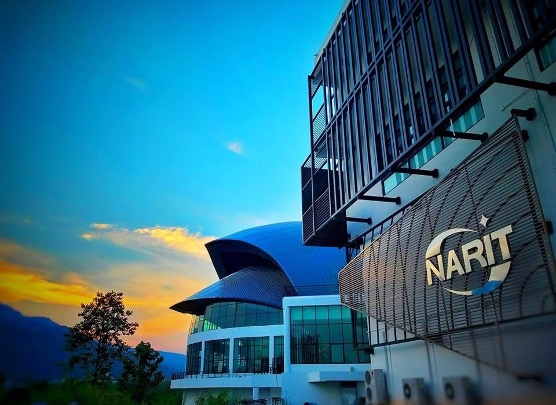
Astropark Facilities:
All ThaiPASS'26 participants are granted exclusive tour to NARIT's engineering facilities within the Astropark campus itself. Among these are the four main buildings in which new innovations are being developed to further advancement in astronomy.
Optics and Photonics Laboratory
Astronomy is a unique field of science that tries to understand the universe only through the tiny specks of light. As such, it becomes a main drive at pushing human technology and innovation forward in order to see better, clearer, and obtaining more information. At NARIT, one of the heart of this is within our optics laboratory where new optics systems are being designed to be used with our national observatory, our spacecraft payload, our atmospheric research, or even our public outreach. Witness some of the state-of-the-art systems currently being tested within our clean room such as the adaptive optics (AO) system, telescope design and development, or the first-of-its-kind an evanescent wave coronagraph, a new type of coronagraph never before conceived anywhere in the world.
Advanced Innovation Center
This new addition to the AstroPark is home to the most sophisticated clean room ever. Within this building, Thailand’s first steps towards space exploration begins to take place. This clean room serves as a testing bed and assembly area for Thai Space Consortium (TSC) new probes to be sent around the Earth, or even towards the Moon. Also sharing the same clean room is where sophisticated detectors for Thai National Radio Observatory are being developed and tested before final implementation.
Advanced Mechanical Manufacturing Center
With over 4 robotics observatories around the world, its engineers work tirelessly to develop systems to control, monitor, and maintain our robotics telescopes around the world. In this lab is where the control systems are being developed. Moreover, as the team and its engineering capabilities grew, we now look into not only servicing telescopes made by others, but to develop new systems on our own as well.
Thin-Film Technology Laboratory
Operating the largest mirror in Southeast Asia is no easy task, and maintaining it is even more so. Apart from regular maintenance, TNO requires recoating of its primary 2.4m telescope every few years. Of course, the largest mirror also means the largest mirror coating machine which needed to be developed from scratch. Thanks to the advancement in the sputtering technique develop in this system, however, was Thailand’s ticket into becoming official partner of international project such as Cherenkov Telescope Array Observatory (CTAO), in which the machine that is going to coat all 6,000 mirrors of CTAO now rests in this lab waiting for deployment.