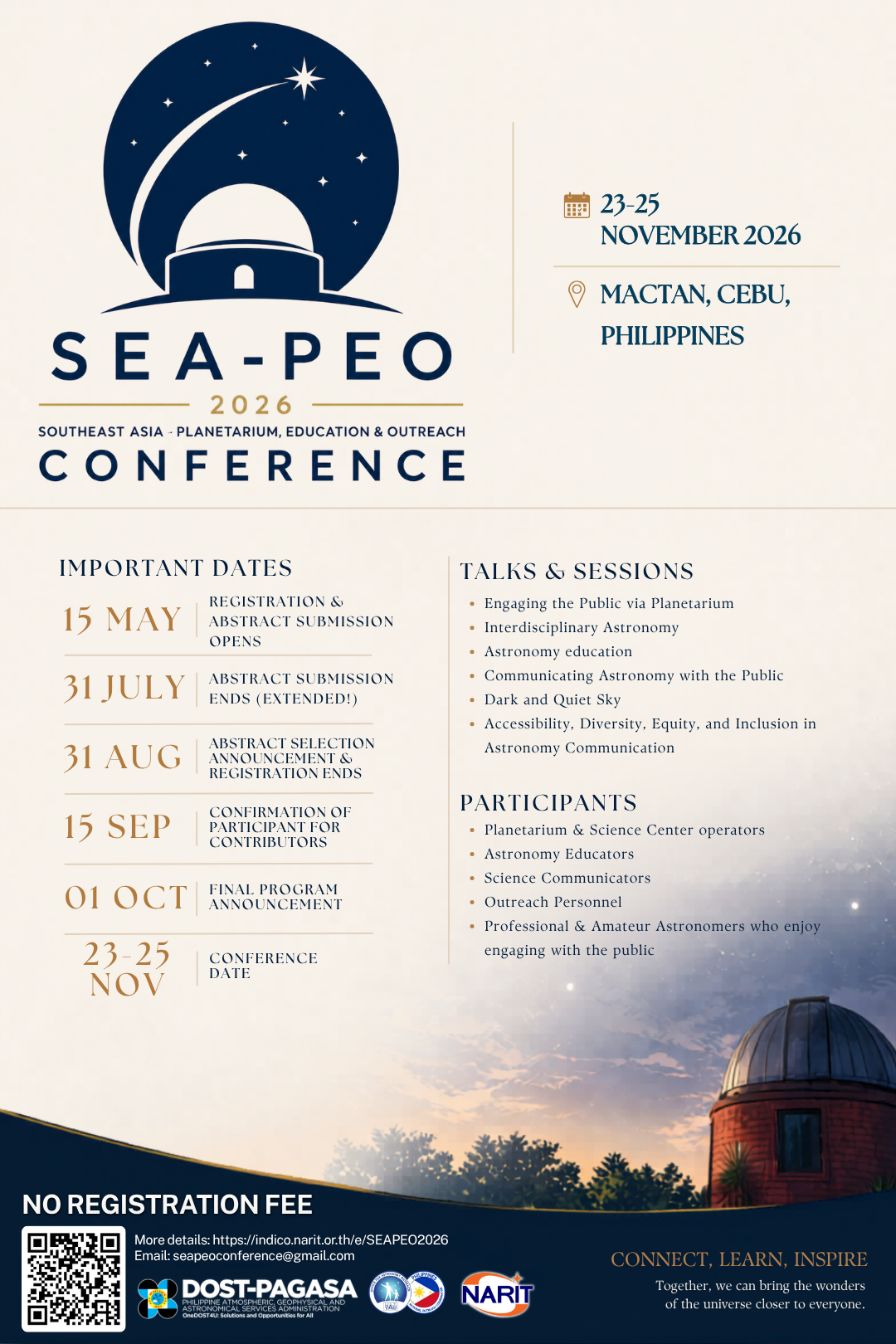
Southeast Asia Planetarium, Education, and Outreach Conference (SEA-PEO 2026)
Dusit Thani Mactan Cebu Resort, Mactan, Cebu
Detail:
The successful conduct of the inaugural Southeast Asia Planetarium, Education and Outreach Conference (SEA-PEO), held on 25-28 November 2024 at Princess Sirindhorn AstroPark, Chiang Mai, Thailand, organized by National Astronomical Research Institute of Thailand (NARIT), highlighted the growing need for a dedicated regional platform where planetarium professionals, educators, and astronomy outreach practitioners can collaborate, exchange best practices, and strengthen public engagement in astronomy across Southeast Asia.
Building on the momentum of this milestone event, the Philippines has been selected by NARIT to host the 2nd SEA-PEO Conference, which will be held on 23-25 November 2026 in Mactan, Cebu. This opportunity recognizes the country’s active role in advancing astronomy education and public outreach through sustained initiatives led by DOST-PAGASA and its partners. Hosting the conference provides a strategic platform to further elevate the Philippines’ contribution to regional capacity-building in science communication, particularly in the use of planetariums and innovative outreach approaches.
The 2nd SEA-PEO aims to continue fostering regional cooperation by bringing together stakeholders from across Southeast Asia to share emerging practices, technologies, and educational strategies that enhance audience engagement and inclusivity in astronomy. It also seeks to address current challenges in outreach, including accessibility, digital transformation, and audience diversification, while promoting collaborative programs and partnerships among institutions.
Date: 23-25 November 2026
Format: In-person
Registration Fee: No registration fee will be collected from confirmed participants; however, travel support will not be provided, and attendees will be responsible for their own travel and accommodation arrangements.
Venue: Dusit Thani Mactan Cebu Resort, Mactan, Cebu
Expected Participants: Planetarium and Science Center operators, astronomy educators, science communicators, outreach personnel, as well as professional and amateur astronomers who enjoy engagement with the public.
-
-
07:30
→
08:30
Registration: Day 1
-
08:30
→
09:00
Ceremony: Opening
-
09:00
→
10:00
Keynote
-
09:00
K01 - Looking Back, Looking Up: Celebrating the Historic 50th Year of PAGASA Planetarium 20m
Planetariums play a vital role in astronomy education, science communication, and public engagement. This review traces the historical development of planetariums in the Philippines, drawing on government records, institutional publications, legal documents, and historical accounts. The earliest documented modern planetarium was established in 1954 at the Philippine Weather Bureau's Astronomical Observatory in UP Diliman, followed by the National Planetarium in 1975 and the PAGASA Science Garden Planetarium in September 1977—the country's first operational planetarium. Originally fitted with a Zeiss-type projector and an MS-8 Minolta projector, and designed with 88 seats symbolizing the 88 recognized constellations, the PAGASA Planetarium has served for nearly five decades as a cornerstone of astronomy education, delivering live shows and lectures to generations of students and the public.
The planetarium's evolution reflects the broader modernization of Philippine astronomy-learning facilities: from analog, mechanical star-projection systems to digital, mobile, and full-dome technology. A key milestone came in June 2014, when the PAGASA Planetarium transitioned to digital projection with the installation of a Panasonic DLP system—an upgrade that, through sustained preventive maintenance and careful equipment management, has continued operating well beyond its expected service life. Access to astronomy education also expanded geographically with the introduction of PAGASA's mobile planetarium in 1999 and the establishment of regional planetariums in Mindanao (2024) and the Visayas (2025), decentralizing services beyond Metro Manila.
As the PAGASA Planetarium approaches its 50th anniversary in 2027, this presentation reflects on its historical and technological journey while addressing the challenges of aging infrastructure and plans to procure a new digital projection system. Together, these developments underscore sustained institutional commitment to modernizing science education facilities, expanding public access, and strengthening scientific literacy and appreciation of astronomy among Filipinos. The lessons drawn from sustaining and upgrading a national planetarium—long-term planning, diligent maintenance, and continuous innovation—offer valuable guidance for preserving science education infrastructure that inspires curiosity and public engagement for future generations
Speaker: Mr Michael Bala (DOST-PAGASA) -
09:20
K02 - Role of Research Institute in Influencing Lasting Impact on the National Level 20m
Eighteen years ago, Astronomy was a foreign concept in Thailand. Then, the National Astronomical Research Institute (NARIT) was founded. Today, Thailand is on the path of becoming world renown research institute, bolstering Southeast Asia's largest optical and radio telescope with robotic telescopes around the world and members of many international collaborations. This level of achievements under such a short time scale has rarely been observed anywhere in the history, if at all. In order to accomplish this, the role and responsibility in which a research institute serves its public had to be reconsidered from the ground up. By taking the public's science awareness as its sole responsibility, NARIT has opened a new path for which research institutes can operate, justifying its existence and gaining lasting public support. The success of NARIT in establishing astronomy as a new core science in the context of developing country perhaps can shed a light that utilizing astronomy as a tool to push forward human capacity and technological development for the public is a viable strategy in gathering lasting support for a research institute.
Speaker: Matipon Tangmatitham (National Astronomical Research Institute of Thailand (NARIT)) -
09:40
K03 - Visualising the Horizon: Toward an Ecological Theory of Science Communication 20m
The United Nations has set a global benchmark for tertiary education enrollment by 2030. While the situation has improved over the years, progress is slowing in many nations. The share of women (particularly those with intersectional identities) graduating from these programmes falls below this benchmark, and those from non-Western countries (e.g., Africa and Latin America) also lag behind.
STEM outcomes show a similar trend, though effects from the so-called Leaky Pipeline lead to the exclusion of women and other historically underrepresented groups. For example, Indigenous, Aboriginal, and First Nations groups make up a vanishingly small percentage of the STEM workforce, even accounting for their relative population size. These statistics indicate there is a staggering lack of opportunities, support, and representation for these groups in STEM fields.
Studies show that focusing on community, culture, and building trust stimulates STEM identity, particularly among groups historically left out of STEM opportunities. In this talk, we will present a pathway toward improved engagement and uptake of STEM in future generations by utilising an ecological model for science communication based on mutuality and reciprocity.
Speaker: Dr Kelly Blumenthal (IAU-OAO)
-
09:00
-
10:00
→
10:30
Coffee Break 30m
Group Photo
-
10:30
→
11:30
Contributor Session
-
10:30
O01 - Beyond the Classroom: Government-Led Astronomy Education Outreach in the Philippines – Insights from DOST-PAGASA’s Programs 15m
As the International Astronomical Union (IAU) Office for Astronomy Outreach-National Outreach Coordinator and the Philippines' primary agency for astronomical services, the Department of Science and Technology – Philippine Atmospheric, Geophysical and Astronomical Services Administration (DOST-PAGASA) has been providing free and accessible astronomy education outreach, continuously adapting its outreach strategies to engage diverse audiences and promote scientific literacy beyond traditional classroom settings.
Over the years, DOST-PAGASA has expanded its initiatives from the annual National Astronomy Week (NAW, every 3rd week of February) to a nearly year-round program aligned with international astronomical celebrations (February-NAW; March-Women and Girls in Astronomy; April-Global Astronomy Month; May-Dark and Quiet Skies; June-Asteroid Day; August- Philippine Space Week; October-100 Hours of Astronomy & World Space Week). The COVID-19 pandemic prompted a shift to virtual platforms, enabling broader audience reach through webinars, virtual planetarium show, online telescope viewing sessions, and interactive activities. Post-pandemic, the agency has fully transitioned back to in-person outreach, reinstating physical events such as planetarium lectures, public stargazing and telescope viewing, seminars for teachers and workshops for junior high schools and interested participants to enhance direct community engagement. We create a cohesive and impactful outreach schedule by strategically aligning our year-round activities with international astronomy celebrations. Despite the challenges of reaching diverse communities nationwide, DOST-PAGASA's successes demonstrate the vital role of government-led, strategic, and adaptive outreach in democratizing astronomy education and fostering a scientifically literate society, underscoring the necessity of sustained government support for STEM education and national development.
Speaker: Girlie Cortez -
10:45
O02 - Astronomy Meets Pop Culture: On the Movements of Stars and Fandoms 15m
This presentation examines how popular culture, including animation, music, films, and K-pop, can be used to bring astronomy closer to Thai audiences. It presents a selection of successful social media posts that linked popular topics with astronomical ideas, helping the content reach people beyond the usual science audience.
The presentation will also discuss how these connections were developed, what made them work, and how to keep the content engaging while maintaining scientific accuracy. The case studies offer practical lessons for science communicators who want to introduce astronomy to audiences whose main interests may lie elsewhere.
Speaker: Hathaichanok Therdthampaisal (NARIT) -
11:00
O03 - Reimagining the Planetarium as a Space for Science Engagement 15m
Planetariums offer a unique opportunity to bring abstract scientific concepts to life — from the impossibly small to the incomprehensibly vast. This presentation explores how we have leveraged the immersive planetarium environment to engage two key audiences: schools and the public. For schools, we design experiences that connect curriculum content with 21st Century Competencies, fostering curiosity and critical thinking. For the public, we develop special programmes tied to astronomical events or our signature festivals, making complex phenomena intuitive, accessible, and entertaining. Beyond traditional programming, we are reimagining the planetarium experience through new formats — including the pairing of live music with live shows — to create deeper, more multisensory connections with our audiences. Together, these efforts reflect our vision of the planetarium as a dynamic space for science engagement and inspiration.
Speaker: Kai Wei Chan (Science Centre Board) -
11:15
O04 - AI-Assisted Astronomy Outreach 15m
Astronomy communicators are expected to create articles, social media posts, videos, podcasts, and educational materials for different audiences, often while working in small teams with limited time and resources. Artificial intelligence (AI) offers new ways to support this work, but it also brings new challenges, especially in multilingual settings where scientific terminology and local context matter.
This presentation explores how AI can be used as a communication assistant rather than a replacement for people. It can help summarize scientific papers, adapt content for different platforms, draft scripts, improve readability, and generate ideas for educational materials, making it easier for small outreach teams to create content in a variety of formats.
At the same time, AI has clear limitations. It may translate scientific concepts too literally, use inconsistent astronomy terminology, or lose important meaning when adapting content into Bahasa Indonesia and other regional languages. It can also oversimplify research or produce scientifically inaccurate information. These are reminders that AI-generated content should always be checked before it is shared with the public.
The presentation introduces a practical workflow in which AI supports routine tasks while communicators remain responsible for choosing reliable sources, checking scientific accuracy, using consistent terminology, and making the final editorial decisions. Drawing on practical experience from independent astronomy outreach projects in Indonesia, the talk shares lessons that can be adapted by planetariums, astronomy clubs, educators, and outreach organizations across Southeast Asia. The goal is not to replace people with AI, but to show how AI can help small teams communicate astronomy more efficiently while maintaining accuracy, local relevance, and audience trust.
Speaker: Avivah Yamani (langitselatan)
-
10:30
-
11:30
→
12:00
Poster Session: Poster Flash Talk
-
11:30
P01 - Optimal Site Selection for Sidewalk Astronomy at Maragondon, Cavite using Multicriteria Decision Analysis 30m
Sidewalk astronomy is a public-oriented scientific activity that aims increase public’s awareness, understanding and appreciation of astronomy. However, to achieve this goal, organizers of sidewalk astronomy must be able to consider several factors to maximize the learning experience of the public. In this study, light pollution, site area, sightlines, terrain, and accessibility were identified as the key criteria in selecting optimal site for conducting sidewalk astronomy at Maragondon, Cavite, a third-class municipality in Cavite that approximately 60 kilometers away from Metro Manila. These criteria were ranked by sidewalk astronomy organizers as validators based on their importance in conducting sidewalk astronomy. A research instrument was also validated to assess the status for qualitative criteria, namely: sightlines and accessibility. Ten sites were pre-selected at Maragondon, Cavite where sidewalk astronomy activities could possibly be conducted. The qualitative and quantitative data obtained from the five key criteria from these sites were subjected to normalization and multicriteria decision analysis (MCDA) through simple additive weighting (SAW) to determine the optimal site at Maragondon, Cavite. Consequently, the MCDA was able to identify the optimal site given that the five criteria have conflicting objective. The analysis identified that areas further from urban centers, given that they have low levels of light pollution, larger site area, clearer sightlines and flatter terrain could be marked as the optimal site for conducting sidewalk astronomy activities. In the future, this study aims to create a baseline data to determine the most optimal site in the larger research locale.
Speaker: Mr Marion Rodrigo III Mariñas (Cavite State University Naic) -
11:30
P02 - The First Planetarium in Mindanao: DOST-PAGASA Mindanao Planetarium 30m
Astronomy, as a scientific discipline, has remained largely absent from formal academic curricula in Mindanao, leaving a gap in opportunities for students and the public to explore the wonders of the universe. With this, the establishment of the first planetarium developed by DOST-PAGASA in Molugan, El Salvador City, Misamis Oriental marks a groundbreaking step toward making astronomy accessible to the region. This facility is envisioned not merely as an educational space but as a cultural and scientific hub that fosters curiosity, discovery, and appreciation of the cosmos.
The planetarium offers immersive shows that simulate the night sky, allowing audiences to experience celestial phenomena in a vivid and engaging manner. Complementing these shows are interactive exhibits that highlight astronomical concepts, instruments, and discoveries, bridging the gap between abstract science and tangible learning. The planetarium also features an observation deck where stargazing activities are conducted, enabling visitors to directly observe stars, planets, and other celestial bodies. These activities provide hands-on exposure that strengthens both scientific understanding and personal connection to the universe. By integrating education and entertainment, the Mindanao PAGASA Regional Services Division (MPRSD) Planetarium serves as a vital source of astronomical knowledge in a region where formal courses are lacking. It not only enriches public awareness of astronomy but also inspires future generations to pursue scientific inquiry, fostering a deeper appreciation of the skies above.
Speaker: Lyka Sambrano (DOST-PAGASA) -
11:30
P03 - A DIY Light Shielding Hood for Reducing Light Pollution and Improving Night Sky Visibility in Cebu, Philippines 30m
Artificial light at night increasingly obscures the stars, contributes to skyglow and glare, and diminishes opportunities for public engagement with the natural night sky. Although advanced lighting technologies can mitigate these effects, their cost often limits adoption in many local communities. This study evaluated a DIY Light Shielding Hood as an affordable intervention for improving outdoor lighting performance in urban and provincial settings in Cebu, Philippines. A mixed-methods experimental design was employed to compare lighting conditions before and after installation of the shielding hood. Measurements included upward light spill, ground illuminance, visible star counts, and observer-rated glare. Field testing was conducted under comparable nighttime conditions in locations representing contrasting ambient-light environments. The intervention produced substantial improvements across all indicators. Upward light spill decreased by approximately 99% in both settings, while ground-level illumination increased through the redirection of previously wasted light. Visible star counts increased by 110% in the provincial setting and 66.6% in the urban setting. Observer-reported glare was also markedly reduced, resulting in improved visual comfort. Statistical analyses confirmed that these changes were highly significant (p < 0.001). The results demonstrate that simple modifications to existing lighting systems can substantially improve the quality of the nocturnal environment without requiring costly infrastructure replacement. By redirecting light toward intended areas and limiting unnecessary skyward emission, the prototype offers a practical and scalable strategy for responsible outdoor lighting. The study highlights how accessible interventions can support dark-sky conservation, strengthen astronomy awareness, and encourage environmental stewardship in developing communities.
Keywords: light pollution, dark-sky conservation, skyglow, star visibility, responsible outdoor lighting, astronomy communication
Speaker: Mr James Khennet Aying (Cebu Technological University ) -
11:30
P04 - Pre-service science teachers’ evaluation and pedagogical integration of augmented reality applications in earth science instruction 30m
The integration of emerging digital technologies such as augmented reality (AR) presents new possibilities for enhancing science teaching, particularly in representing abstract and dynamic Earth science concepts. However, its instructional value depends on how teachers interpret, adapt, and embed these technologies within classroom practices. Hence, this study examined pre-service science teachers’ evaluation and pedagogical integration of AR applications in Earth science instruction using a convergent mixed-methods design. Participants were third-year pre-service science teachers from a public higher education institution in Central Visayas, Philippines. The study utilized AR applications covering comets, meteors, and asteroids; earthquakes and faults; and typhoons. Quantitative data were collected using a researcher-developed Likert-scale questionnaire based on the Technology Acceptance Model, while qualitative data were gathered through semi-structured interviews and analyzed thematically. Results showed that AR applications were highly evaluated in terms of content relevance, usefulness, and usability. However, qualitative findings revealed that AR was primarily positioned as a supplementary visualization tool rather than a transformative instructional approach. Integration was shaped by contextual constraints, pedagogical reasoning, and developing teacher cognition. The findings highlight the need for teacher education programs to move beyond technology exposure toward reflective, design-oriented preparation that supports meaningful AR integration.
Speakers: Ms Melissa Rodriguez (Cebu Technological University) , Ms Maricho Butalid (Cebu Technological University) , Mr Marjohn Cabo (Cebu Technological University) -
11:30
P05 - Communicating Astronomy and Planetarium Lectures to Children with Autism Spectrum Disorder 30m
Introduction
Planetarium environments—dark domes, sudden loud sounds, abstract celestial motions—can overwhelm children with ASD due to sensory sensitivities and preference for predictability. However, astronomy’s visual and pattern-based nature also offers unique engagement opportunities. This discussion outlines four practical communication strategies to make planetarium lectures accessible, meaningful, and enjoyable for learners on the spectrum.
- Pre-Visit Priming: Replace Surprise with Structure
Children with ASD often experience anxiety from unknown settings. Before the lecture, provide:
· Visual schedules showing the planetarium sequence (enter → sit → dark → stars → story → lights up).
· Social narratives with photos of the dome, projector, and seats.
· Sensory maps indicating “loud parts” or “quiet exit zones.”
· Concrete vocabulary cards (e.g., “orbit = a path around a ball”).- Sensory-Friendly Lecture Delivery
Modify the traditional planetarium format:
· Gradual transitions – dim lights slowly instead of sudden blackouts.
· Adjustable audio – lower volume, remove unexpected sound effects (e.g., rocket launches).
· Permission to regulate – allow fidget tools, sunglasses, or a designated “cool-down corner” without stigma.
· Avoid abstract analogies – instead of “as big as a million Earths,” use physical contrasts (“Saturn could hold 760 Earths like this basket holds beans”).- Communication Techniques for Concept Clarity
Many children with ASD process literal, concrete information best. In the dome:
· Break time into segments – after 10 minutes, turn on low blue light and recap with hand gestures.
· Use repetitive verbal cues – “Look up – now we see the North Star.”
· Pair every celestial event with a tactile or kinesthetic action – “When I say ‘spin,’ turn your chair slowly – that’s Earth’s rotation.”
· Limit metaphoric language – replace “the Sun is a giant ball of fire” with “the Sun is a very hot, glowing sphere of gas.”- Embedding Special Interests & Predictable Routines
Leverage common ASD strengths: pattern recognition, detail focus, and intense interests.
· Offer interest-based versions – a “Train Constellation” tour or “Planet colors” focus for a child fascinated by colors.
· Use the same opening ritual each time – “First, lights fade. Second, three blinking stars appear. Third, we count down: 3-2-1 – dome.”
· Provide a visual check-sheet of things to find (e.g., “Find the red dot – that’s Mars”).Conclusion
Communicating astronomy to children with ASD does not require simplifying the science; it requires adapting the delivery to respect sensory and cognitive needs. By using priming, sensory modulation, literal language, and structured routines, planetarium educators can transform potential distress into genuine discovery. These strategies align with universal design principles—benefiting all learners while making astronomy truly inclusive.
Speaker: Mary Crystalline Araracap -
11:30
P06 - A systematic mapping review of astronomy education research in Southeast Asia: Trends, innovations, challenges, and research directions 30m
Astronomy education research has expanded in response to increasing interest in space science, technological innovation, and interdisciplinary STEM learning. However, the landscape of astronomy education research in Southeast Asia remains fragmented, with limited synthesis of prevailing themes, pedagogical approaches, innovations, and research directions. This study maps the landscape of astronomy education research in Southeast Asia by examining research trends, thematic focus areas, instructional innovations, key pedagogical approaches, educational findings, and persistent challenges and gaps. A systematic mapping review of 35 peer-reviewed studies was conducted using a structured screening and thematic coding process. The findings reveal that astronomy education research in the region is strongly oriented toward technology-enhanced learning, space engineering and STEM-based initiatives, and inquiry-oriented approaches. Major astronomy topics investigated include general astronomy concepts and solar system-related phenomena, space systems and engineering applications, and space science outreach. Experiential learning, technology-enhanced learning, inquiry-based learning, and project-based learning emerged as dominant pedagogical approaches. Synthesized findings indicate that most studies report improvements in conceptual understanding, scientific skills, engagement, and interest in STEM. However, persistent challenges include limited infrastructure and accessibility, scalability constraints, technology-related barriers, and gaps in teacher preparedness. The review further highlights research gaps related to long-term impact evaluation, broader empirical validation, improved assessment approaches, curriculum integration, and inclusive astronomy education. Overall, astronomy education in Southeast Asia demonstrates strong innovation potential but requires more sustained, longitudinal, and context-responsive research to support equitable and impactful astronomy learning.
Speaker: Mr Dharel Acut (Cebu Technological University; Cebu Normal University) -
11:30
P07 - Examining the effects of a blended station rotation environment on students’ motivation in earth and space science learning: a pretest–posttest study 30m
Motivation plays a critical role in students’ engagement and persistence in learning Earth and Space Science, particularly when exploring abstract topics such as planetary systems, space exploration, and celestial phenomena. This study investigated the effects of a blended station rotation model on students’ motivation toward Earth and Space Science learning. Employing a quasi-experimental one-group pretest–posttest design, the study involved 119 Grade 10 students from four intact classes enrolled in an Earth Science elective course at a university laboratory school in Northern Mindanao, Philippines. The four-week intervention covered selected Earth and Space Science topics, including the Solar System, terrestrial and Jovian planets, planetary exploration, and astronautics, through teacher-guided instruction, technology-supported learning, and collaborative hands-on activities. Students’ motivation was measured before and after the intervention using an adapted Students’ Science Motivation Questionnaire II (SMQ-II). Paired-samples t-tests revealed significant improvements in students’ overall motivation, intrinsic motivation, self-efficacy, and career motivation. Effect size analysis further showed that intrinsic motivation demonstrated the largest standardized effect among the motivational dimensions. These findings suggest that blended station rotation models can foster motivation by providing authentic, interactive, and learner-centered astronomy learning experiences. The study underscores the potential of blended instructional approaches for promoting meaningful engagement in Earth and Space Science education.
Speaker: Mr Gilden Maecah Migalang (MSU Iligan Institute of Technology; University of the Philippines Open University) -
11:30
P08 - Students’ motivational experiences in planetary science learning through a blended station rotation model: A multiple case study with creative artifacts 30m
Understanding how students experience motivation within blended learning environments remains an important yet underexplored area in science education. This multiple case study explored students' motivational experiences during a blended station rotation model implemented in a Grade 10 planetary science unit. Guided by Self-Determination Theory, the study examined four motivational cases: intrinsic motivation, self-efficacy, self-determination, and academic grit, and synthesized common motivational patterns across cases while analyzing students' creative artifacts as representations of their learning experiences. Data were collected through individual open-ended responses, focus group discussions, and student-generated artifacts, and were analyzed using within-case and cross-case thematic analyses. Findings revealed that motivation developed as an interconnected process in which curiosity initiated engagement, successful task completion strengthened confidence, autonomy fostered ownership of learning, and perseverance sustained participation through increasingly challenging activities. Creative artifacts, including the Saturn gown, Martian robot, Jupiter cake analogy, and Neptune–Uranus comic, demonstrated how students transformed scientific concepts into meaningful visual representations while reflecting distinct motivational experiences. The cross-case synthesis further showed that these motivational dimensions mutually reinforced one another rather than functioning independently. The findings extend theoretical understanding of motivation in blended science learning while providing implications for science teaching practice, curriculum and instructional design, and future research on student-centered learning environments.
Speakers: Mr Gilden Maecah Migalang (MSU Iligan Institute of Technology; University of the Philippines Open University) , Mr Dharel Acut (Cebu Technological University; Cebu Normal University) -
11:30
P09 - Project TALA: Developing A Scalable Syllabus Framework for Informal Astronomy Education in the Philippines 30m
Astronomy plays a vital role in advancing scientific literacy; however, astronomy instruction in the Philippines remains largely limited to foundational concepts within the K–12 curriculum, providing few opportunities for learners to explore advanced topics and develop practical skills. The lack of structured informal astronomy programs and age-appropriate instructional resources further limits meaningful engagement with astronomy and space science. To address this gap, the Valenzuela City League of Astronomy Enthusiasts (V-CLUE) developed Project TALA (Teaching Astronomy to Local Audience), the first astronomy summer school camp for youth in the Philippines, centered on a structured learning for the youth aged 15–18.
The syllabus was designed using a learner-centered approach and underwent content validation by the DepEd Schools Division Office of Valenzuela and professionals in astronomy to ensure scientific accuracy, pedagogical appropriateness, and alignment with learner needs. It was organized into four major astronomy themes that progressively introduced concepts rarely discussed in the K–12 curriculum, including observational astronomy, telescope operations, stellar evolution, galaxies, cosmology, and space exploration. Each session combined lectures with hands-on workshops and was supported by learning experiences such as telescope observations, facility visits, reflective activities, and a capstone project. The instructional sequence was guided by Kolb's Experiential Learning Cycle and the 5E Instructional Model to promote inquiry, conceptual understanding, and application.
Implementation outcomes demonstrated that the structured progression of topics and experiential learning design effectively sustained participant engagement, achieving a 96.43% attendance rate across 12 sessions, with all participants completing the program. Participant evaluations also indicated consistently high ratings for lecture delivery, learning environment, and engagement. These findings suggest that a validated, developmentally appropriate syllabus can serve as an effective framework for informal astronomy education, complementing the Philippine K–12 curriculum while providing a scalable model for community-based astronomy programs that promote astronomy literacy and youth engagement in science.
Keywords: astronomy education, informal astronomy education, curriculum development, astronomy literacy, experiential learning
Speakers: Ms Moreen Lamsen (Valenzuela City League of Astronomy Enthusiasts (V-CLUE)) , Mr Mark Anthony Aguilando (Valenzuela City League of Astronomy Enthusiasts (V-CLUE)) -
11:30
P10 - ASTRO-KS Model: Building a Participatory Astronomy Learning Ecosystem for School and Rural Communities in Thailand. 30m
Astronomy can foster scientific literacy, critical thinking, imagination, and competencies essential for twenty-first-century learners. Nevertheless, many rural schools face barriers to high-quality astronomy education, including limited access to scientific instruments, specialist expertise, authentic data, learning resources, and hands-on scientific experiences. This study presents and evaluates the ASTRO-KS Model, a school-based framework developed at Khuruprachasan School in Chainat Province, Thailand, to build a participatory astronomy learning ecosystem under the guiding principle of “Astronomy for All”. The model seeks to position rural schools as hubs for astronomy learning, student research, science communication, and community engagement.
The ASTRO-KS Model comprises seven interconnected and mutually reinforcing components: (1) Access and Awareness, expanding access to astronomy and strengthening public awareness; (2) School-Based Astronomy System, integrating astronomy into curricula, classroom instruction, extracurricular activities, and school management; (3) Talent and Team Development, strengthening the capacities of students, teachers, youth leaders, and implementation teams; (4) Research and Real Experience, engaging learners with astronomical observations, authentic data, scientific instruments, and research processes; (5) Outreach and Opportunity, communicating astronomy to the public and broadening learning opportunities for schools and communities; (6) Knowledge-Sharing Network, facilitating the exchange of knowledge, resources, and effective practices; and (7) Sustainability, establishing mechanisms for continuity, scaling, and long-term implementation.
A case-study programme evaluation was conducted using implementation data collected between 2023 and 2026. Data sources included activity records, participant registers, student research and innovation outputs, presentation records, network documentation, and participant evaluation surveys. The data were analysed using content analysis and descriptive statistics. The model systematically integrates classroom learning, a young scientists club, astronomy camps, student research projects, teacher professional development, student academic conferences, interschool collaboration, and public astronomy outreach.
The learning ecosystem expanded to seven secondary schools and fifteen primary schools across several provinces in Thailand, generating more than 12,000 cumulative participant engagements. Students developed more than 50 astronomy and STEM projects covering observational astronomy, astrophysics, spectroscopy, astronomy education, and integrated STEM learning. Student and teacher outputs were presented or recognised at national and international forums, including CAAS, TACs, K–12 Astro Asia, SEA-PEO, and national science and innovation events. Community outreach incorporated more than 50 hands-on learning activities, public sky observations, student-led science communication, and cultural performances. Among survey respondents, mean satisfaction was 4.72 out of 5.00, while the proportion of students expressing interest in further STEM study or careers rose from 58% in the pre-activity survey to 87% in the post-activity survey.
The findings suggest that the ASTRO-KS Model is a promising, practice-oriented framework for inclusive and participatory astronomy education. By connecting school-based learning, youth development, authentic research, public science communication, collaborative networks, and local culture, the model may be adapted and scaled in rural and resource-constrained settings to promote equitable access, strengthen school–community partnerships, and support sustainable astronomy learning ecosystems in Thailand and across Southeast Asia.
Keywords: ASTRO-KS Model, astronomy education, learning ecosystem, science communication, community engagement, educational equity, rural schoolsSpeaker: Mr Witchaphon Puangkaew (Khuruprachasan School, Secondary Educational Service Area Office Uthai Thani Chai Nat, Thailand.) -
11:30
P11 - “KAWANANGAN : ASTRONOMICAL CENTER OF OBSERVATORY FOR ACADEMIC RESEARCH AND DEVELOPMENT IN MINDANAO” 30m
The Cosmos is the primary resource for astronomical science that is connected by the Astronomical Center of Observatory for Academic Research and Development in Mindanao, Philippines. However, the field of astronomical science requires further development to achieve its full potential according to PAGASA. This project aims to elevate the nation’s scientific landscape, thereby fostering its growth.
Recognizing the scientific limitations of the country, the purpose in implementing the study is to build up opportunities for Filipinos, inspiring them to aim higher and to comprehend the vastness of what is beyond humans can possibly reach that could lead to national scientific development. It is pursuing to contribute to space discoveries, innovation and invention, unlocking possibilities for potential groundbreaking contributions. Site selection process was conducted, primarily utilizing Multi-criteria Decision Analysis for Optical Observatories, with the goal of maximizing the observatory’s capabilities through the architectural perspective.
The results of this study recommend Indulang, Talakag, Bukidnon, Philippines as the selected location. This finding signifies a significant step towards establishing a foundation for research and development within the Philippines, opening up their horizon to become a global key contributor to space exploration and discovery, while also generating local economic opportunities and fostering educational advancements in STEM fields with the assistance of the architectural design.
Speaker: Jessamine Jayson -
11:30
P12 - Planetarium Workshop: An Extracurricular Astronomy Program for Elementary School Students 30m
Kawasaki Municipal Science Museum is a museum of astronomy and natural sciences with a planetarium, which is equipped with an 18-meter dome and the opto-mechanical planetarium “MEGASTAR-III FUSION” by Ohira Tech.
We have a planetarium workshop for elementary school students in grades 4 through 6. The workshop consists of sessions held over 7-month period and provides hands-on experience in learning about basic astronomical knowledge and the mechanism of a planetarium that simulates a real starry sky.
The purpose of this workshop is to deepen children’s interest in astronomy, space, and science through the experiences, and to give them opportunities for unique experiences of learning at a planetarium which cannot be offered in schools.
The children research and prepare their own manuscripts on topics of interest and collaborate with other participants to create a 45-minutes planetarium show. In the show held on the final day of the workshop, they stand at the console to operate it by themselves and give a presentation on the starry sky.In this presentation, I will introduce the content of the workshop and would like to discuss the benefits of using the planetarium as a venue to connect with the general public, particularly elementary school children.
Speaker: Satoka Tanaka (Kawasaki Municipal Science Museum) -
11:30
P13 - The First Astronomy on Tap in the Philippines - Learnings and Best Practices 30m
Astronomy on Tap (AoT) is a worldwide network of events in which astronomers and related professionals & students give short presentations in pubs and cafes, allowing the public to connect with experts in a relaxed environment. Last March 2026, AoT Manila was launched, becoming the first AoT "satellite" in the Philippines and the sixth in Asia. AoT Manila is currently organized by the Philippine Society of Space and Astronomy Research (PSSAR) and student volunteers from various universities within Metro Manila. In this poster, we will share some of the lessons the organizers and volunteers have learned from organizing AoT Manila that differ from those in other AoT satellites, such as our "comedy" Astronomy on News segment, special sessions given by invited speakers, and experts who visit the Philippines that end up becoming speakers in our sessions. Finally, we will present some of the feedback that we have received from the audience. We hope to encourage other countries and cities without AoT yet to start their own AoT in their respective areas.
Speaker: Daryl Joe Santos (Rizal Technological University) -
11:30
P14 - Empowering Rural Students through Research-Based Astronomy Education: Development of the ASTRO-KHURU Project-Based Learning Model in a Thai Secondary School 30m
Access to authentic astronomy research experiences remains limited for many students in rural schools, particularly in contexts where scientific equipment, specialist support, and opportunities for advanced inquiry are not readily available. This study presents the development and implementation of the ASTRO-KHURU Model, a project-based astronomy learning model designed to promote astronomical research competencies among secondary school students in a rural Thai school context. The study aimed to: 1) develop a project-based astronomy learning model integrated with the ASTRO-KHURU framework, 2) construct and validate the quality of the developed instructional model, and 3) examine the effects of the model by comparing students’ post-learning abilities in planning and conducting astronomical research with the 80% criterion, alongside a qualitative analysis of students’ learning behaviors and research skill development.
The target group consisted of 35 upper secondary school students from Khuruprachasan School, Chainat, Thailand, who voluntarily participated in the project “Astro Research Kick-off: Igniting Dreams, Cultivating Young Astronomy Researchers.” The participants were selected through purposive sampling. The research instruments included: 1) the ASTRO-KHURU instructional model, developed through the integration of Project-Based Learning, systems thinking, and the PDCA cycle; 2) an astronomical research skills assessment; and 3) field note and learning reflection forms. Data were analyzed using descriptive statistics, including mean and standard deviation, a one-sample t-test, and content analysis.
The findings revealed that the ASTRO-KHURU Model was operationalized through nine structured learning stages: A: Activate Curiosity, S: System Thinking and Science Literacy, T: Teamwork and Topic Selection, R: Research Design, O: Observation and Operation, K: Knowledge Construction, H: Highlight and Presentation, U: Use of Feedback, and R: Reflection and Future Path. These stages enabled students to engage in astronomy research through curiosity-driven inquiry, collaborative topic development, systematic research design, hands-on observation, knowledge construction, academic presentation, feedback-based improvement, and reflective planning for future learning.
The quality evaluation showed that the appropriateness of the model, as assessed by experts, was at the highest level (Mean = 4.43, S.D. = 0.38). The instructional efficiency of the model was 82.12/88.45, exceeding the established 80/80 criterion. After implementation, students’ astronomical research skills reached 89.66%, which was significantly higher than the 80% criterion at the .01 level. Students’ overall satisfaction with the learning model was high (Mean = 4.52, S.D. = 0.41), with the highest-rated aspect being “inspiration for future learning and careers in science” (Mean = 4.68). Content analysis of students’ reflections further indicated that 100% of the students were able to clearly describe their cognitive development, acquired research skills, and inspiration for further study in space science.
These findings indicate that the ASTRO-KHURU Model is an effective instructional approach for promoting active learning and developing astronomical research competencies among secondary school students in rural educational contexts. The study demonstrates that, when rural students are provided with a structured learning process, meaningful mentorship, and opportunities to engage in authentic scientific inquiry, they can develop research skills, confidence, and motivation to pursue astronomy and space science. The model therefore offers a practical and scalable framework for expanding research-based astronomy education, reducing opportunity gaps, and cultivating young astronomy researchers in rural and underserved schools.
Keywords: ASTRO-KHURU Model, project-based learning, astronomy education, rural school, astronomical research competencies, young astronomy researchers, active learning, research-based learning
Speakers: Mr Witchaphon Puangkaew (Kuruprachasan School, Secondary Educational Service Area Office Uthai Thani Chai Nat, Thailand) , Mr Phongpathapee Thaikiew (Kuruprachasan School, Secondary Educational Service Area Office Uthai Thani Chai Nat, Thailand) -
11:30
P15 - AGOS institute for advanced science, culture, and sustainability 30m
While Pasig City continues to advance student welfare and educational access, a gap still remains in specialized, immersive infrastructure capable of bridging traditional classroom learning with applied scientific inquiry, indigenous culture, and urban environmental care. Standard educational spaces lack the advanced technology needed to inspire and nurture future researchers, limiting opportunities for interdisciplinary exploration. To address this, this proposal outlines the framework for the AGOS Institute for Advanced Science, Culture, and Sustainability in Barangay Ugong, Pasig City. The project redefines the traditional observatory model by integrating astronomical facility design with ethnoastronomical documentation, public education, and riverfront ecological management along the Pasig River.
The proposed methodology applies sustainable urban planning and universal design principles to create an accessible, multi-use civic asset. Sited near the C5 corridor and the Maybunga Ferry Station, the facility leverages low-carbon, river-based transit access. The spatial plan incorporates riverbank eco-restoration, public function spaces, an accessible annex library, and commercial allocations intended to support local micro, small, and macro-enterprises. This design directly aligns with Pasig City’s 5-Point Focus Agenda on Access to Quality Education and Resources, while addressing UN Sustainable Development Goals 4 (Quality Education), 8 (Decent Work and Economic Growth), and 9 (Industry, Innovation, and Infrastructure). The project is structured around the AGOS framework: Angkan (Lineage/Ethnoastronomy), Gabay (Guidance/Education), Oportunidad (Opportunity/Accessibility), and Suporta (Support/Research Infrastructure).
The anticipated deliverable is a scalable scientific and cultural facility anchored by a multi-use dome projection system. Beyond standard planetarium shows, the dome is designed to serve as a visualization medium for cross-disciplinary data, scientific conferences, and cultural programming. Complemented by an accessible annex library, open public halls, local commercial hubs, and local green space, the AGOS Institute offers a practical blueprint for integrating astronomical facility design, environmental management, and community engagement.
Keywords: Digital Planetarium, Ethnoastronomy, Public Science Communication, Eco-Cultural Center
Speaker: Mr Mar Emmanuel Velasco (Philippine Astronomical Society, Inc.) -
11:30
P16 - Dark Sky Tanay: Assessing the Night Sky Brightness of Tanay, Rizal using VIIRS Nighttime Lights and Vertical Plane Imaging 30m
Tanay, Rizal has become one of the most frequented destinations for camping, stargazing, and outdoor recreation in the Philippines due to its relatively dark skies, elevated terrain, and accessibility from Metro Manila. However, increasing tourism development, expanding infrastructure, and the growing use of artificial outdoor lighting pose potential threats to the quality of its nighttime environment. As light pollution continues to increase globally, the preservation of naturally dark areas has become an important concern for astronomy, ecology, sustainable tourism, and environmental conservation. This study aims to establish a baseline assessment of the light pollution conditions and dark-sky potential of Tanay through the integration of satellite-based and ground-oriented imaging techniques.
The study utilizes VIIRS Suomi-NPP Cloud-Free Moonlight-adjusted Nighttime Lights data to quantify artificial light emissions and evaluate spatial patterns of nighttime radiance in and around candidate observation sites. Temporal and spatial analyses are conducted using zonal statistics, confidence intervals, and radiance trend assessments to identify areas experiencing increasing levels of artificial illumination. To complement the satellite analysis, vertical plane imaging employing fisheye-lens photography is used to characterize the distribution, intensity, and color temperature of local lighting sources and to identify potential contributors to skyglow and light trespass. The combined methodology follows established approaches in astronomical site assessment and light pollution research, allowing both large-scale and localized evaluation of nighttime lighting conditions.
The research provides a preliminary characterization of the night-sky environment of Tanay and identifies areas where increasing artificial lighting may affect the visibility of celestial objects and the quality of outdoor nighttime experiences. By combining remote sensing with site-level imaging, the study offers a framework for monitoring light pollution in emerging astrotourism and ecotourism destinations. The findings are expected to support future efforts in responsible lighting management, dark-sky conservation, astronomy education, and sustainable tourism planning. Furthermore, the study highlights the importance of proactive monitoring and mitigation measures to preserve the remaining dark skies of Tanay as a valuable scientific, environmental, and cultural resource for future generations.
Keywords: Light Pollution, Dark-Sky Conservation, Tanay Rizal, VIIRS Nighttime Lights, Vertical Plane Imaging, Astrotourism, Night Sky Brightness, Sustainable Tourism, Astronomy Education.
Speaker: Mr Benedick James Baclig -
11:30
P17 - Connecting Astronomy with Environmental Stewardship: A Community Based Public Outreach Model at Bosscha Observatory 30m
Public outreach has become an essential part of the role of modern astronomical observatories, complementing research and education by building connections with surrounding communities. However, outreach activities have relatively limited emphasis on demonstrating how astronomy can be connected to environmental issues that are directly relevant to surrounding communities. This project aims to develop a community based public outreach model that connects astronomy with environmental stewardship by drawing on the ecological context of Bosscha Observatory, Indonesia.
Developed as part of the 2026 Bottom-Up Public Engagement Program, the model adopts a participatory approach that integrates astronomy education, environmental outreach through astronomy, and Sundanese ecological knowledge. Outreach activities begin by introducing the origin of water in the Universe and Earth's uniqueness as a habitable planet. These ideas are then connected to the role of Bosscha Observatory as a water recharge area within the upper Cipaganti watershed, providing a scientific context for discussions on local environmental conservation.
The outreach model brings together local schools, youth organizations, farmers, women's groups, university students, and community partners through educational workshops, field observations, environmental action, and collaborative reflection. Throughout these activities, astronomical concepts are introduced in the context of local environmental issues, helping participants relate astronomy to environmental challenges in their own communities.
By connecting astronomy with locally relevant environmental issues, the model broadens the role of observatories beyond research and education to include public engagement. Although developed in the context of Bosscha Observatory, the model demonstrates how locally relevant environmental issues can serve as an effective entry point for astronomy public outreach. This approach may be adapted by other observatories seeking to strengthen relationships with surrounding communities.
Keywords: Astronomy public outreach, Community engagement, Environmental stewardship, Environmental education, Observatory
Speaker: Fauzia La Fatsa (Bandung Institute of Technology) -
11:30
P18 - Igniting Young Minds Through Experiential Astronomy Education: Advancing Astronomy Awareness and Science Engagement in Northern Luzon, Philippines 30m
Astronomy is an effective tool for promoting scientific literacy, critical thinking, and interest in Science, Technology, Engineering, and Mathematics (STEM). Following the Astronomy Teacher Training Program jointly conducted by the Philippine Atmospheric, Geophysical and Astronomical Services Administration (PAGASA) and the National Astronomical Research Institute of Thailand (NARIT), trained teachers and PAGASA personnel implemented astronomy outreach activities to introduce students in Northern Luzon to basic astronomical concepts through experiential learning.
The initiative engaged elementary and secondary school students in lunar eclipse observation, constellation-making, and guided stargazing activities. These hands-on experiences enabled students to observe celestial objects directly and understand the relationship between the Earth, Moon, and Sun, planetary motion, seasons, and other natural phenomena. By connecting astronomical events to everyday life, the activities encouraged curiosity, scientific inquiry, and a greater appreciation of Earth's place in the universe.
The outreach demonstrated that experiential astronomy education is an effective approach to increasing students' interest in astronomy and STEM while enhancing teachers' confidence in delivering astronomy lessons. The program also strengthened public awareness of astronomy by making scientific concepts more accessible to young learners.
The initiative highlights the importance of sustained collaboration among government agencies, educational institutions, and local communities in expanding astronomy education. Integrating observation-based activities into science learning provides meaningful opportunities to inspire the next generation of scientists and foster a scientifically literate society.
Keywords: Astronomy education, science outreach, STEM education, astronomy observation, youth engagement, PAGASA, NARIT, Northern Luzon.Speaker: Mr Romeo Ganal (DOST-PAGASA) -
11:30
P19 - Development of a Self-Paced Basic Astronomy Training Program (MOOC) to Enhance the Competencies of DOST-PAGASA Astronomy Lecturers 30m
The DOST-PAGASA Space Science and Astronomy Section developed a competency-based, self-paced Basic Astronomy Training Course to standardize and enhance the technical and pedagogical competencies of astronomy lecturers assigned to PAGASA Regional Services Division (PRSD) mobile and fixed planetariums. Designed as a blended learning program, the course integrates asynchronous online instruction with performance-based, face-to-face practical training to provide a scalable and sustainable capacity-building framework for regional personnel.
The first phase of the course is purely online, which involves completion of SCORM modules about the basics of astronomy. This presentation will discuss the development of the training course, its instructional design, and its role in standardizing astronomy education across PAGASA's regional services division.Speaker: Ms Jastine Michaela Adduru (DOST-PAGASA) -
11:30
P20 - Bringing the Universe Closer: Expanding Astronomy Education Through DOST-PAGASA's Mobile Planetarium and Stargazing Outreach Program 30m
The DOST-PAGASA Space Science and Astronomy Section (SSAS) conducts the Mobile Planetarium and Stargazing Outreach Program to bring astronomy education and public engagement activities to schools, government agencies, local communities, and other institutions throughout the Philippines. The program is implemented through DOST-PAGASA-initiated outreach activities during astronomy celebrations and science events, as well as upon request from institutions seeking astronomy lectures and immersive learning experiences.
Outreach activities typically include mobile planetarium shows, lectures on basic astronomy and the night sky, telescope viewing sessions, and discussions of current astronomical events. These activities provide participants with engaging and interactive opportunities to learn about astronomy beyond the traditional classroom setting.
This poster highlights the implementation and geographic reach of the outreach program over the years. A map of outreach locations across different regions of the Philippines will illustrate the extent of DOST-PAGASA's efforts to expand access to astronomy education nationwide. The presentation will also provide an overview of participant demographics, demonstrating that the majority of beneficiaries are students and teachers from elementary, secondary, and higher education institutions.
The poster showcases how mobile planetariums and telescope observing sessions have become effective tools for science communication, strengthening partnerships with educational institutions and inspiring greater public interest in astronomy across the country.
Speaker: Ruben Cunanan (PAGASA) -
11:30
P21 - Cosmic Perspectives: Using Astronomy to Support Mental Health and Wellbeing 30m
Looking up at the night sky can shift how people feel about their own worries. The sense of awe and vastness that astronomy brings pull attention into the present moment and helps us change what feels important. These same shifts sit at the heart of Acceptance and Commitment Therapy (ACT) which is a practice built around accepting difficult feelings, stepping back from unhelpful thoughts, and reconnecting with what matters.
This talk looks at how the perspective astronomy offers, and the simple act of being under the stars, can be used to support mental health and wellbeing. Building on the IAU Astro for Mental Health initiative, it connects stargazing to the language of ACT and to the wellbeing that comes from being in nature, showing why astronomy outreach is well suited to encouraging acceptance, perspective, and connection.Speaker: Rheanne Jimeno (Space Generation Advisory Council) -
11:30
P22 - Egg Nebula: Bringing the Stars Closer to Filipinos through Art and Digital Storytelling 30m
Astronomy can feel hard to reach— full of numbers, distances, and ideas that are tough to picture. Egg Nebula is a digital science communication platform that treats stories and art as the way in, turning complex concepts and data into experiences the public can actually understand and enjoy.
At the center of this talk is a digital planetarium where users trace their own shapes among the stars and build stories around them. The idea grew from an in-person event where children, asked to find their own patterns in the sky, came up with strikingly different readings of the same stars — much like how early Filipino traditions saw figures such as Balatik and Moroporo. Turning the planetarium into a space where people create and tell their own star stories, rather than just watch, makes astronomy both easier to grasp and more engaging.
More widely, the talk shows how stories and pictures help people make sense of hard, data-heavy science. Using Egg Nebula's projects as examples, the talk lays out simple design ideas for building digital, story-driven astronomy experiences, and shares how the platform is being brought back and grown for wider use.Speaker: Rheanne Jimeno (Space Generation Advisory Council) -
11:30
P23 - Designing a Learning Space for Astronomy Outreach: A Case Study from Khon Kaen, Thailand 30m
Astronomy outreach activities often depend on weather conditions and clear skies. On cloudy or rainy nights, or before the sky becomes dark enough, telescope observations cannot be carried out as planned. Therefore, one of the main challenges in astronomy outreach is not only organizing stargazing activities, but also creating meaningful learning experiences that can continue even when the sky cannot be observed. This idea led to the development of the Learning Space at the Regional Observatory for the Public, Khon Kaen.
The Regional Observatory for the Public, Khon Kaen, under the National Astronomical Research Institute of Thailand (NARIT), organizes NARIT Public Night every Saturday throughout the year from 6:00 p.m. to 10:00 p.m. The program allows visitors to explore astronomy through telescope observations. To address this challenge, the observatory developed the Learning Space, an indoor area where visitors can continue learning while waiting for darkness or when sky observations are not possible. The Learning Space follows an interactive learning approach and includes three main areas: the Kids Zone, which offers simple activities for children; the Toy Zone, where visitors can enjoy educational toys and learning materials; and the Workshop Zone, where visitors take part in simple hands-on activities. Workshop topics change every week to provide new learning experiences and encourage visitors to return.
The Learning Space was designed to support continuous astronomy learning alongside telescope observations. It offers hands-on activities for visitors of all ages and provides greater flexibility for public outreach programs at the observatory. This case study shows that a well-designed learning space can enhance visitors' learning experiences and provide an effective approach to astronomy outreach when weather conditions limit telescope observations.Speaker: Kewalin Thongpoyai (Regional Observatory for the Public, Khon Kaen) -
11:30
P24 - Thai Heritage and ASEAN Astronomy Learning Ecosystem: An Integrated Astronomy Education Framework through Mission-Based, Jigsaw, Game-Based, and Active Learning 30m
Astronomy education provides a unique opportunity to integrate scientific inquiry with cultural heritage and interdisciplinary learning. However, astronomy instruction in many schools remains largely lecture-based, limiting students' opportunities to engage in authentic scientific investigations and connect astronomical concepts with local contexts. Thailand and ASEAN countries possess rich astronomical heritage embedded in temples, archaeological sites, traditional calendars, architectural alignments, and indigenous knowledge. Despite their educational value, these resources are rarely incorporated into formal astronomy education. To address this challenge, Buddhajak Wittaya School developed the Thai Heritage and ASEAN Astronomy Learning Ecosystem, an educational framework integrating classroom instruction, extracurricular learning, heritage-based field experiences, and community outreach through Mission-Based Learning, Jigsaw Learning, Game-Based Learning, and Active Learning.
The framework was designed to (1) integrate astronomy with science, history, culture, mathematics, geography, and local wisdom; (2) promote inquiry, collaboration, and problem-solving; (3) enhance astronomy achievement and twenty-first-century competencies; and (4) strengthen astronomy communication and community engagement.
The learning ecosystem consisted of five interconnected components: Classroom Astronomy, Astronomy Club, Thai Heritage and ASEAN Astronomy Camp, Heritage Field Study, and Community Astronomy Outreach. The Thai Heritage and ASEAN Astronomy Camp served as the central learning experience through five mission-based learning activities, where students worked collaboratively in expert teams using Jigsaw Learning to solve authentic astronomical challenges through inquiry, evidence collection, collaborative investigation, and scientific communication.
The five missions consisted of Mission 1: Decoding the Solar Temple, in which students investigated the astronomical orientation of Buddhist temples by measuring solar shadows, determining cardinal directions, constructing simple sundials, and interpreting how ancient civilizations applied solar observations in sacred architecture; Mission 2: The Lost Lunar Calendar, where students reconstructed the traditional Thai lunar calendar from historical evidence while exploring lunar phases, Buddhist festivals, agricultural traditions, and indigenous astronomical knowledge; Mission 3: ASEAN Sky Explorer, in which students compared constellations, celestial navigation, and indigenous astronomical knowledge across ASEAN civilizations to understand astronomy as a shared cultural heritage; Mission 4: Solar Tracker, where students investigated the apparent motion of the Sun through direct observations and field measurements to explain Earth's rotation, seasonal changes, solar altitude, and sunrise–sunset positions; and Mission 5: Stargazer Navigator, in which students interpreted star maps, identified constellations, observed celestial objects through telescopes, and applied celestial navigation techniques to determine directions and explain astronomical phenomena. Each mission incorporated Game-Based Learning through puzzles, astronomy detective tasks, escape challenges, collaborative investigations, and reflective discussions to promote active participation, critical thinking, conceptual understanding, and interdisciplinary learning.
A total of 430 participants, including 80 upper-secondary students from Buddhajak Wittaya School and 350 primary school students from ten partner schools in Bangkok, participated in the program. Students' mean achievement scores increased significantly from 9.18 ± 2.31 before participation to 16.74 ± 1.94 after the program, representing a 70.1% improvement (p < .001). Reflective journals and semi-structured interviews revealed increased scientific curiosity, stronger appreciation of Thai and ASEAN astronomical heritage, improved teamwork, enhanced science communication skills, and greater confidence in applying astronomy to authentic cultural contexts.
The findings demonstrate that integrating Mission-Based Learning, Jigsaw Learning, Game-Based Learning, and Active Learning within a heritage-based astronomy learning ecosystem effectively promotes conceptual understanding, interdisciplinary thinking, scientific inquiry, and public engagement. The framework also establishes sustainable partnerships among schools, temples, and local communities while preserving and communicating Thailand's and ASEAN's astronomical heritage. This model offers a scalable and transferable approach for Astronomy Education, Interdisciplinary Astronomy, and Communicating Astronomy with the Public throughout Southeast Asia.
Keywords: Astronomy Education; Interdisciplinary Astronomy; Astronomical Heritage; Mission-Based Learning; Jigsaw Learning; Game-Based Learning; Active Learning; Community Outreach; Thailand; ASEAN.
Speaker: Natthawat Najaiyen (Buddhajakwittaya School) -
11:30
P25 - Beyond the Dome: The Planetarium as a Gateway to Astronomy and Science Education in the Visayas 30m
The Visayas Planetarium, operated by the Visayas PAGASA Regional Services Division (VPRSD) in Cebu, Philippines, is emerging as a regional platform for astronomy education, public engagement, and informal STEM learning. While the planetarium primarily introduces visitors to astronomy and space science through immersive digital experiences, its potential extends beyond the dome by connecting astronomy with Earth science, atmospheric science, weather, and climate.
Since opening to the public in 2025, the Visayas Planetarium has attracted an increasing number of visitors, with students and educational institutions comprising the majority of its audience. The growing interest demonstrates the potential of the planetarium to serve not only as a venue for astronomy education but also as a gateway to broader scientific learning.
Speaker: Vhan Therese Sabellano (PAGASA) -
11:30
P26 - Alternative Conceptions of Senior High School Students to Astronomy Concepts 30m
Introduction
Filipino students are required to undertake the revised basic education curriculum (RBEC, or K–12 curriculum) from kindergarten up to senior high school set by the Department of Education (DepEd). Included in the revised curriculum are astronomy concepts that are taught at different grade levels in junior high school (from Grade 7 up to Grade 9). Topics in Grade 7 include the concepts of seasons and eclipses. Characteristics of asteroids, comets, and other members of the solar system are taught in Grade 8, while characteristics of stars and constellations are taught in Grade 9. (Department of Education, 2016)
The arrangement of topics in astronomy and other science concepts in elementary and junior high school is patterned using a spiral progression curriculum. This curriculum was promoted by Bruner. Bruner (1960) encourages different educational institutions to teach concepts first at a more simplified level, but as the learner progresses, those concepts will be relearned and they will add concepts that are more complex but related to the first one. Thus, concepts will have a gradual increase in difficulty. To assess the effectiveness of the curriculum, the Bureau of Educational Assessment conducts the National Achievement Test (NAT) for junior high and senior high school students. Based on the latest result of the NAT, the national result is 44.1% in the school year 2016–2017, which is lower compared to the 44.7% result in the school year 2015–2016. (Aguinaldo, 2019) However, scores in relation to astronomy concepts are not included. One of the perennial problems in curriculum assessment is the alternative conceptions of students.
Alternative conception is defined as the students’ personal construct of knowledge that is different from the universally accepted scientific facts (Chhabra & Baveja, 2012). Also, Gilbert (1983) defined alternative conception as an idea or thought of a learner that is different from the socially agreed concept. If the student learned an alternative concept, it may be difficult to unlearn or change due to the high resistance of the learner to change it. (Novak, 1988) In recent years, there have been numerous studies that focus on identifying the difficulties students have in comprehending different astronomical concepts (Kharis, 2016). However, there is scarce literature on the alternative conceptions of astronomy concepts among students in the Philippines. Based on this, researchers would like to determine the different alternative conceptions of astronomy concepts taught to senior high school students during junior high school.
Methods
The researcher used a qualitative descriptive survey design. According to Calmorin & Calmorin (2007), this design is best suited to determining the degree of differences between the subjects. Also, the researcher will determine the variation of participants in different conditions and situations.
The participants of the study were the Grade 11 senior high school students. Grade 11 students were the participants because they already learned about astronomy topics in junior high school. Also, the researcher assumes that they have no astronomy concepts learned in their grade 11 subjects in science (Earth Science, Physical Sciences, Earth and Life Science, and DRRR) in relation to the chosen astronomy topics since those topics are not included in the curriculum guide of the said subjects. The researcher employed stratified random sampling. Stratified random sampling used layering techniques. In each layer or stratum, the participants were selected randomly. (Calmorin & Calmorin, 2007).
The previous junior high school of each participant will be considered in this study. This is to make sure that the participants came from different junior high schools and to increase the variability of the answers. After classifying the students in stratification, the researcher will use systematic random sampling to select the students randomly.
The researcher used a guided or structured interview to determine the alternative conceptions of astronomy concepts among senior high school students. The researcher and the participant used video conferencing applications for the interview. The guided or structured interview consists of pre-formulated questions that will help the researcher answer the formulated problems. To answer the first question, the researcher will include two sets of questions. The first set of questions will assess the known understanding of the subject of eclipses (solar and lunar eclipses). The second set of questions will determine their understanding of seasons. For the answers to the second question, the research will include questions that will determine how the participants acquired those alternative conceptions. For the third question, the interview guide will consist of questions that will determine the factors influencing how they acquired those conceptions. These guided or structured interview questions were designed by the researcher. The researcher will also make a table of specifications for the questions. This will allow the researcher to align the questions with the required competency in astronomy in the science curriculum guide from the Department of Education. The questions from the interview guide were submitted to the research adviser to check and to give comments and suggestions. After that, the researcher seeks the guidance of astronomy professors at the Department of Earth and Space Science at Rizal Technological University to validate the content of the questions.
Results
The different results and analyses are presented in the order of sub-problems of this study, as follows: Senior high school students have alternative conceptions of different astronomy concepts covered by the curriculum guide for junior high school students.
In the concept of a solar eclipse, students have alternative conceptions if they explain the concept in verbal form rather than in diagram form. The alternative conceptions of students in drawing form are the Earth-Sun-Moon model and the Moving Sun and Moon model. For the verbal form, the alternative conceptions are: (1) solar eclipses happen at night; (2) the sun and moon are moving towards each other; (3) when the moon rotates, it covers the sun; and (4) the moon is blocking the path of the sun.
In the concept of a lunar eclipse, students also commit alternative conceptions if they explain the concept in verbal form rather than in diagram form. In the diagram form, the alternative conceptions of students are: (1) the moving moon and sun model; and (2) the earth-moon-sun model. Students also commit alternative conceptions if they explain them verbally. These are: (1) light emitted from the Moon was blocked by Earth; (2) the Moon disappeared during a lunar eclipse; (3) Earth came between the Sun and Moon; (4) the Moon blocked the sunrays reflected on the Earth; (5) the mechanism of a lunar eclipse was the same as that of a solar eclipse; (6) the Moon was blocking Earth’s light; and (7) the Sun was blocking the Moon during the nighttime.
However, for Philippine seasons, there is no difference between the verbal and diagram forms. The alternative conceptions in drawing form are: (1) distance of the Earth from the Sun; and (2) local weather model. Also, students have alternative conceptions regarding the names of the seasons, like (1) rainy and summer, (2) winter and summer, (3) El Nino and La Nina, and (4) sunny, rainy, and typhoon. In verbal form, these are the alternative conceptions of students: (1) the northern hemisphere experiences a rainy and sunny season, while the southern hemisphere experiences winter and autumn; and (2) if the Philippines is not in the spotlight of the sun, then it is a rainy season. Otherwise, if the country is in the spotlight, then it is sunny or “tag-init” and (3) if the Earth is farther from the Sun, then it is rainy. If near, then it is summer; (4) the Philippines is located at the center of the equator; and (5) the Philippines is experiencing balanced day and night. Students acquired those alternative conceptions through the pedagogy of their teachers (length of instructional time, teaching methods), the surfing of the internet and social media, the personal experiences of the students, and the visual representation of the mechanisms of the astronomy concepts.
Conclusions
The results of the study led the researcher to conclude that senior high school students have alternative conceptions of different selected astronomy concepts that are included in their junior high school lesson. The researchers noticed that students gave more alternative conceptions if they explained the concepts in verbal form than in drawing form. This conclusion is true for the concepts of solar and lunar eclipses but not for Philippine seasons. Also, students gave a higher alternative conception of the mechanism by which lunar eclipses work than solar eclipses, both in verbal and in drawing form. Based on the responses of the respondents, the research also concludes that students acquired those alternative conceptions through the pedagogy of the teacher (which includes the length of instructional time and teaching methods), the use of the internet and social media as information sources, the personal experiences of the students, and the visual representation of those phenomena.
Speaker: Dr Ryan Manuel Guido (Rizal Technological University) -
11:30
P27 - How to Start Astronomy in School: A Collaborative Pathway from First Activities to Student Leaders and Community Outreach 30m
Many schools are interested in introducing astronomy education but often face challenges in starting a program due to limited teacher experience, insufficient resources, and uncertainty about how to create meaningful learning opportunities. As a result, astronomy activities may remain occasional events rather than developing into a continuous learning culture involving students and communities. This presentation shares a practical pathway for starting astronomy education in a school setting through collaboration, student leadership, and community engagement.
The initiative was developed at Rongkwang Anusorn School, Thailand, through a collaborative approach involving teacher development, administrative support, student participation, resources from the National Astronomical Research Institute of Thailand (NARIT), and partnerships with external organizations. After participating in introductory astronomy teacher training, the school began with small-scale activities using available resources, including star-map activities, telescope observations, celestial object observations, and astronomy media. These initial experiences gradually expanded through support from NARIT, including a 10-inch reflecting telescope and a mobile planetarium, leading to the establishment of the Astro R.A. Astronomy Club.
The program focused on transforming students from astronomy learners into astronomy leaders. Twenty student leaders were trained in astronomical knowledge, scientific process skills, science communication, activity design, and learning facilitation. They developed and delivered astronomy learning activities through stargazing stations, mobile planetarium sessions, solar observations, astronomy camps, and night-sky observations for students from different age groups and members of the public.
During one academic year, the program conducted seven major activities across six venues, reaching a cumulative attendance of 1,960. The activities extended astronomy learning beyond the classroom to other schools and local communities. Observations and reflections indicated that student leaders developed greater confidence in communication, teamwork, leadership, and activity management, while participants gained increased interest and positive attitudes toward astronomy through direct experiences.
The initiative received the Outstanding School Astronomy Activity Award and the Rising Star Award at the 7th Conference on Astronomy Activities in Schools (CAAS). This experience demonstrates that schools can begin astronomy education with small steps and gradually expand through collaboration, empowering students as facilitators, and connecting astronomy learning with wider communities.
Speaker: Thanarat Sabsom
-
11:30
-
12:00
→
13:00
Lunch 1h
-
13:00
→
14:00
Poster Session: Poster Session / Exhibitor Showcase
-
14:00
→
15:00
Workshop: Parallel Session Ballroom III (Dusit Thani Mactan Cebu Resort)
Ballroom III
Dusit Thani Mactan Cebu Resort
-
14:00
W02 - 2-Stage Water Rocket Workshop: A Model for Promoting Active Learning and Developing Student Competencies through Integrated STEM Education 1h
The 2-Stage Water Rocket Workshop is a hands-on learning activity that helps schools promote Active Learning by giving students the opportunity to learn through direct experience. The workshop makes difficult physics concepts easier to understand by allowing students to build, test, and launch a two-stage water rocket with a stage separation mechanism. Through this process, students gain a clear understanding of the concept of multi-stage rockets and the basic principles of physics in a practical way. The activity also inspires interest in science, engineering, and space technology while connecting classroom knowledge with real-world applications.
During the workshop, students follow the Engineering Design Process, including identifying a problem, planning, recognizing design constraints, building a prototype, testing, and improving their design. The activity also integrates the four areas of STEM Education into a single learning experience: Science (motion, force, and air pressure), Technology (tools and mechanisms), Engineering (designing, building, and improving the rocket), and Mathematics (measurement, calculation, and ratios).
This learning approach also helps schools develop important student competencies, including critical thinking, problem-solving, teamwork, and communication. Because the workshop involves challenging engineering tasks, students also learn resilience by understanding that failure is a natural part of the learning process. They are encouraged to analyze mistakes, improve their designs, and try again. As a result, the workshop provides a challenging, enjoyable, and motivating learning experience that supports the development of well-rounded learners and offers an effective STEM learning model that can be applied in schools.Speaker: jessada Keeratibharat (NARIT)
-
14:00
-
14:00
→
15:00
Workshop: Parallel Session Ballroom II (Dusit Thani Mactan Cebu Resort)
Ballroom II
Dusit Thani Mactan Cebu Resort
-
14:00
W01 - Let's Light Up a Constellation: Illuminating Philippine Ethnoastronomy Through Paper Circuits 1h
This interactive workshop introduces participants to Philippine ethnoastronomy through a creative maker-based activity that combines cultural heritage, astronomy, and basic electronics. Inspired by the "Let's Light Up the Constellations" activity developed by the Italian National Institute for Astrophysics (INAF), the workshop replaces familiar Western constellations with selected Indigenous Philippine constellations, offering a culturally relevant approach to astronomy education.
The session will feature selected traditional constellations, such as Balatik and Moroporo, and discuss their correspondence with modern constellations recognized by contemporary astronomy. The hands-on portion of the workshop will guide participants in creating an illuminated paper-circuit constellation using conductive copper tape, LEDs, and a coin-cell battery. Working from prepared templates, participants will assemble a simple electrical circuit that lights up the stars of an Indigenous constellation while learning the basic principles of circuit design and conductivity. Facilitators will provide step-by-step guidance, making the activity suitable even for participants with no prior experience in electronics.
By the end of the session, participants will have completed their own illuminated constellation model, gained practical experience in paper-circuit technology, and acquired ideas and resources for adapting this low-cost, hands-on activity to engage diverse audiences while promoting appreciation of the Philippines' rich astronomical heritage.
Speaker: Lordnico Mendoza
-
14:00
-
15:00
→
15:15
Coffee Break 15m
-
15:15
→
17:00
Contributor Session: Parallel Session Ballroom III (Dusit Thani Mactan Cebu Resort)
Ballroom III
Dusit Thani Mactan Cebu Resort
-
15:15
O12 - Development of the Astronomy Teacher Training Curriculum and Learning Activities by the National Astronomical Research Institute of Thailand (NARIT) 15m
The National Astronomical Research Institute of Thailand (NARIT) has consistently conducted astronomy workshop programs to enhance the capacity of in-service teachers since its establishment in 2009. The primary objective is to elevate teachers' subject-matter knowledge and pedagogical skills, which directly translates to the improved learning outcomes of their students. To ensure the curriculum remains current and aligns with rapid scientific and technological advancements, the program undergoes a systematic review and revision every 4 to 5 years. Although the NARIT curriculum is not strictly bound to the national core curriculum, its continuous development is strategically designed to meet the modern professional needs of educators while aligning with the Institute’s visionary goals.
Rather than focusing solely on conventional academic lectures, the curriculum's framework emphasizes two primary strategic objectives. First, it addresses scientific misconceptions - a critical challenge in science education. Assessments, including pre- and post-tests alongside ongoing observational evaluations, reveal that many teachers hold misconceptions regarding fundamental phenomena, such as the apparent motion and phases of the Moon. Second, the program focuses on developing innovative, contemporary learning activities. These activities emphasize active learning and are intentionally designed to be practical, allowing teachers to easily adapt and implement them in their respective classrooms.
In conclusion, the periodic revision of the curriculum ensures the training program remains modernized and highly engaging. A notable indicator of its success is the significant re-entry rate of alumni teachers returning to acquire new skills and experience newly introduced activities. Furthermore, evaluation data confirm that this iterative process effectively rectifies scientific misconceptions. The continuous implementation of this program serves as a vital mechanism for driving and expanding astronomical education and activities across the broader school system.
Keywords: Astronomy Education, Teacher Training, Professional Development, Scientific Misconceptions, Active Learning.
Speaker: Mr Khomsan Thuree (NARIT - National Astronomical Research Institute of Thailand (Public Organization)) -
15:30
O13 - ITCA Teacher Training Workshop: Expanding Access to Astronomy Education Through International Teacher Training 15m
Astronomy education has received more interest in recent years, with growing demand for professional astronomical resources. However, accessibility gaps remain a recurring problem in many regions around the world. To help bridge this gap and promote equal access to educational opportunities, the ITCA Teacher Training Workshop was developed for international audiences. The primary objective of this workshop is to equip educators as key contributors to passing on knowledge to future generations with practical tools, accurate content, and inclusive approaches to improve astronomy instruction in diverse classroom settings.
Many educational systems and cultures, particularly in developing countries, still rely on traditional, passive learning methods that struggle to keep up with the needs of today’s learners. As such, hands-on and active learning activities, connecting astronomy to real-life experiences relevant to teachers and students are keys to implementing impactful changes to the participants. For instance, reconceptualizing familiar phenomena through an activity comparing themselves to the Earth to learn the moon phases more clearly. Realizing the vast scale of the solar system simply by walking through a scale model. The materials used in all activities are widely available and easily adaptable with local resources—ensuring that teachers could confidently bring these activities into their own classrooms. The workshop has been conducted with collaboration with local partners across Southeast Asia, including Laos, Myanmar, Malaysia, Timor-Leste, Singapore, Indonesia, Vietnam and Philippines. It has also expanded to other regions, such as Nepal and Botswana.
Participants gained effective and accurate methods for communicating astronomy in simple and accessible manners, and they were inspired by unique experiences and fresh ideas that they can apply and implement in their instructional contexts—passing on knowledge from generation to generation. These outcomes help ensure that astronomy can connect people across borders in a sustainable way. Future collaborations with interested partners from around the world are welcomed, with the aim of continuing to encourage educators globally, aligning with NARIT’s mission “Leave no one behind.”
Speaker: Rujida Kuramarohit -
15:45
O14 - Enhancing STEM Engagement at the High School Level: A Pedagogical Framework for Optics and Waves Instruction via Astronomical Instrumentation 15m
Astronomy serves as a potent catalyst for advancing Science, Technology, Engineering, and Mathematics (STEM) education, leveraging its inherent visual appeal to stimulate intellectual curiosity regarding the cosmos. Within the context of secondary education in Indonesia, however, physics is frequently delivered through a predominantly theoretical lens, often lacking clear links to practical applications. This abstraction can lead to significant conceptual disconnects and a subsequent decline in student engagement. To address this pedagogical challenge, the Bosscha Observatory, acting as an academic laboratory under the Bandung Institute of Technology (ITB), has developed a strategic framework designed to bridge the gap between theoretical physics and experiential application.
This framework integrates astronomical principles into the high school physics curriculum, specifically targeting the domains of optics and waves. By utilizing astronomical observing instruments as primary didactic tools, the program transforms abstract physical laws into observable, tangible phenomena. The initiative involves the systematic development of hands-on modular activities and workshops that are rigorously aligned with the Indonesian National Physics Curriculum. These modules not only reinforce mandatory learning objectives but also introduce supplementary content, thereby extending the students' knowledge base beyond standardized requirements. Through this inquiry-based approach, students are encouraged to explore the functional relevance of physics in both scientific research and daily life.
The program is projected to yield substantial improvements in scientific literacy and foster a sustained vocational interest in STEM disciplines. By reinforcing the nexus between classroom instruction and real-world application, this initiative highlights the observatory's critical role in demonstrating how fundamental physics principles underpin modern technology and our understanding of the universe.
Speaker: Luthfiandari Luthfiandari (Bosscha Observatory) -
16:00
O15 - Connecting Classrooms to the Universe: Enhancing Astronomy Education through Planetariums 15m
Astronomy is one of the most inspiring subjects in the school science curriculum, but teaching it in a standard classroom comes with challenges. Most lessons rely heavily on flat 2D images, diagrams, and textbook explanations. As a result, many students struggle to clearly understand complex concepts, such as the scale of the universe, planetary motions, and space missions. Planetariums offer a powerful solution to bridge this gap. By turning static concepts into immersive visual experiences, planetariums can create dynamic learning spaces that increase student engagement and conceptual understanding.
This presentation introduces an ongoing educational program that integrates Korea’s national science curriculum with planetarium technology, using SkyExplorer software. The program focuses on space exploration, allowing students to virtually travel through the Solar System, visit distant space probes, and observe celestial events from dynamic perspectives. We will share practical ideas for program development, demonstrate key educational content, and discuss how immersive planetarium experiences can strengthen astronomy education in schools.
Speaker: Mr Sanghyun Ha (METASPACE / Korea National University of Education) -
16:15
O16 - Celestial Sphere Project - Affordable and mass produced model of the celestial sphere 15m
The concept of a Celestial Sphere is among the concepts in astronomy that many find least intuitive to understand. This is an area where a handheld model can help immensely in visualizing the concept. However, a bad model can hinder a person's ability to understand while a good model can be cost-prohibitive and the amount limitations prevents it from being hands-on. In this work we attempt to address these issues by developing a celestial sphere models that are affordable by using paper and beach ball as the media. A normal equirectangular map is transformed using cassini map projection via a script run on graphics software to preserve vector graphic editability. Different projections centered at varying meridians called "gore" is created and together forms interrupted map projection. A 6-gore interrupted map projection is printed on a transparent polyvinyl surface with two azimuthal equidistance projection as the cap to form a beach ball version. Additionally, a 12-gore version is printed on paper with interlocking mechanism that allows an even more affordable version to be printed anywhere. With additional base plate, altitude and azimuth dials, the paper version can be fully equipped to perform simple instructions. These two versions offer powerful alternatives to teaching about celestial sphere at the fraction of a cost.
Speaker: Matipon Tangmatitham (National Astronomical Research Institute of Thailand (NARIT)) -
16:30
O17 - Comparative analysis of Astronomy and Space Science topics in the middle and high school curricula of Vietnam and the Philippines 15m
In Southeast Asia, there is a growing need by governments like those of the Philippines and Vietnam to develop their country’s respective space industries. The ability to do quality astronomy research, while not directly leading to economic gains, is a marker of academic prestige that could also be a useful part of nation building narratives these governments espouse. Corollary to these development and patriotic goals is to produce a reliable pool of homegrown workers with the requisite motivation, skills, and talent. One specific way governments can do this is by crafting a science education curriculum which identifies and narrows down the priority topics that would need to be given time in classroom instruction. This paper undertook a comparison of the astronomy and space science topics in the science curricula of the Philippines and Vietnam, with a focus on middle and high school levels, to have a preliminary assessment of the priorities and direction of each state’s astronomy and space science education. Curriculum mapping and content analysis were used to compare the competencies and learning goals of each country side by side. The congruence of their topics’ coverage with the broader Big Ideas in Astronomy identified by the International Astronomical Union (IAU) as well as the astronomy and space science-related competencies of the United States’ Next Generation Science Standards (NGSS) were also assessed. The Bloom’s taxonomy framework was then used to rank how much of Vietnam and Philippines’ astronomy and space science competencies align with particular levels of thinking. From these results, potential strengths and weaknesses were identified for further action by stakeholders and education policymakers in each respective country.
Speaker: PAUL CHRISTIAN YANG-ED (Laniakea Ventures) -
16:45
O18 - Astronomy Research-Based Learning as an Alternative to Classroom Education 15m
Astronomy is a globally recognized field that inspires people of all ages and serves as a powerful gateway to science, technology, engineering, and mathematics (STEM). The National Astronomical Research Institute of Thailand (NARIT) is dedicated to advancing astronomy and astrophysics through scientific research, education, and public outreach. One of its key educational initiatives is the Astronomy Research-Based Learning Workshop, which provides an alternative learning experience beyond the traditional classroom.
The workshop adopts a research-based learning approach, allowing students to gain hands-on experience by conducting authentic astronomical research. Through this program, participants develop practical astronomy skills while strengthening their understanding of the scientific method and critical thinking—competencies that are essential for the 21st century but are often underemphasized in conventional education. Students analyze real observational data collected by robotic telescopes, learn to use professional astronomical software, and conduct their research under the guidance of experienced astronomers.
More importantly, the workshop encourages students to think like scientists. Rather than simply following predetermined activities, they are encouraged to formulate their own research questions, investigate astronomical phenomena that interest them, and develop evidence-based conclusions. This inquiry-driven approach helps students cultivate creativity, problem-solving skills, and scientific curiosity while providing valuable insight into astronomy as a potential career.
To further strengthen research-based extracurricular learning, NARIT established the Thai Astronomical Conference (TACs), a national platform where secondary school students present their astronomy research projects. Over the past decade, TACs has showcased more than 500 student research projects, providing young researchers with opportunities to exchange ideas, receive feedback from experts, and gain valuable presentation experience. During the past three years, outstanding projects have also been recognized with medals, encouraging students to continue pursuing research and innovation in astronomy.
Through these initiatives, NARIT demonstrates that astronomy can be far more than a classroom subject. By engaging students in authentic scientific research and providing opportunities to communicate their findings, research-based learning not only enhances scientific knowledge but also develops the critical thinking, creativity, and research skills needed to prepare the next generation of scientists and innovators.Speaker: sawatkamol pichadee
-
15:15
-
15:15
→
17:00
Contributor Session: Parallel Session Ballroom II (Dusit Thani Mactan Cebu Resort)
Ballroom II
Dusit Thani Mactan Cebu Resort
-
15:15
O05 - Communicating Astronomy in the Philippines: Themes, Trends, and Trajectories 15m
Communicating astronomy in the Philippines involves addressing challenges such as a limited curriculum, insufficient teacher training, and infrastructure constraints while leveraging emerging technologies and fostering multi-sector collaborations. This paper is a meta-analysis of empirical studies, program evaluations, policy reviews and case studies, surrounding the conduct of communicating astronomy in the Philippines. It covers the period of 2015 to 2025 with the enactment of the Philippine Space Act in the middle of the time period. This study shows that most of the studies conducted are in the urban and national-level studies. There is also emerging themes on rural and indigenous contextualualization, the use of technology in communicating astronomy in rural settings, and integration of indigenous astronomical knowledge as well as the involvement of communities in astronomy outreach. Future strategies should consider decentralizing outreach, getting into culturally responsive approaches and the robust evaluation of innovative platforms like augmented reality applications.
Speaker: Mark Ivan Roblas (Philippine Council for Industry, Energy and Emerging Technology Research and Development) -
15:30
O06 - Expanding Astronomy Outreach: An Adult-Centered Online Program for Parents in Indonesia 15m
Children are natural questioners, and their curiosity about the world around them often leaves adults searching for answers. Science, particularly astronomy, is part of our daily life. Children’s questions are inseparable from a starry night sky, a moon that always follows us, and a big yellow sun in the day. As a child's primary educators and first points of reference, parents are expected to answer these questions anytime and anywhere. This reality calls on parents to prepare themselves to be learning buddies for their children.
In Indonesia, online astronomy programs are widely available, but almost exclusively designed for children. Programs intended for adult learners, particularly parents, remain rare or virtually nonexistent. While parents often accompany their children in these classes, the content is tailored for children and does not deepen the parent's own understanding of astronomy. Recognizing this gap and acknowledging that parents are a child's first learning buddy, we developed Astronomy for Parents, an online astronomy program designed specifically for mothers and fathers. Becoming a parent does not mean stopping learning; if anything, it demands more of it, as children grow and their questions only multiply.
The program held its first session in June 2026 on the topic of Stars and Planets, chosen as the most familiar and observable topic for parents with no prior astronomy background. Each session follows four segments: an opening hook question, concept exploration, a simple hands-on activity, and a Q&A discussion. Eight participants attended the pilot session. All participants rated the content as easy to understand, and seven of the eight indicated a desire to return for future sessions. These early findings suggest that an adult-centered approach to astronomy outreach for parents can be effective in terms of engagement and home-based learning. We look forward to sharing this work to expand astronomy outreach in Indonesia through the langitselatan programme.
Speaker: Ajeng Tri Handini (langitselatan) -
15:45
O07 - Fake News: Turning Social Media Panic into Astronomy Learning Moments. 15m
In the social media age, scary headlines and false astronomy news spread quickly, creating confusion and public panic. Science communicators need more than just hard facts. We need fast and practical ways to handle these digital rumors.
This presentation shares real life lessons from the National Astronomical Research Institute of Thailand (NARIT) on acting as a trusted source for astronomy news. By drawing on well known examples, such as solar storm panics and exaggerated asteroid warnings, we will break down NARIT’s 4 step guide to tackling fake news:
1.Early Detection: Catching rumors on social media before they go viral.
2.Clear and Kind Messaging: Explaining the science simply without sounding patronizing or repeating false claims.
3.Smart Media Use: Leveraging eye catching infographics, short videos, and news networks to spread the truth fast.
4.Turning Fear into Learning: Transforming public worry into engaging, real time science lessons.Attendees will gain a clear understanding of the step by step process for managing misinformation through NARIT’s proven case studies. This approach demonstrates how to effectively manage public panic and turn it into great science learning opportunities.Speaker: Piriyaporn Sabhasri -
16:00
O08 - Communicating Astronomy Through Social Media: The Astronomical Diary Video Series 15m
Astronomical events occur throughout the year, yet many remain unnoticed due to limited access to reliable, timely, and easy-to-understand astronomy information. To enhance public engagement, the DOST-PAGASA Space Science and Astronomy Section produces the Astronomical Diary Video Series, a monthly astronomy video presentation derived from the agency's Astronomical Diary Press Release and published on the official DOST-PAGASA Facebook page.
Launched in February 2021, the series features upcoming astronomical events visible from the Philippines, including meteor showers, planetary conjunctions, lunar phases, eclipses, and other notable celestial phenomena. Using the open-source planetarium software Stellarium, together with narration, graphics, animation, and video editing, each episode simulates the night sky and provides practical observing guidance to help viewers appreciate and observe these events.
To date, approximately 65 episodes have been published, providing students, educators, amateur astronomers, and the general public with accessible and reliable astronomy information. This presentation describes the development and production workflow of the Astronomical Diary Video Series, from script adaptation and sky simulation to video production and dissemination through social media. It also discusses the use of regular monthly video presentations as a digital science communication strategy for improving public access to astronomy information and enhancing public engagement with astronomy.
Speaker: Rizzalyn Joy Agustin (DOST-PAGASA) -
16:15
O09 - Bringing Astronomy to the Public: The Development of “Starry Night over Bangkok” and “Starry Night in the Park” as Innovative Public Astronomy Engagement Programs 15m
The National Astronomical Research Institute of Thailand (Public Organization) (NARIT) has developed astronomy festivals under "Starry Night" series, with the aim of bringing astronomy beyond observatories into public spaces, promoting science awareness, while supporting dark sky awareness and astrotourism.
These programs were designed as interactive Astronomy Festivals, anticipating wide range of audience and interests featuring telescope observations, naked-eye constellation tours, astronomy exhibits, hands-on workshops, science communication activities, children's learning zones, and public talks by professional astronomers. The activity design emphasizes experiential learning, allowing participants of all ages to directly engage with astronomical phenomena in an informal learning environment.
The implementation has demonstrated remarkable public participation. The inaugural "Starry Night over Bangkok" attracted more than 12,000 participants, while the second event welcomed over 36,000 visitors, making it one of the largest stargazing event known worldwide. The activities successfully reached diverse audiences, including families, students, educators, amateur astronomers, tourists, and the general public. Many additional spinoff series emerged over other location under the name "Starry Night over..." has replicated similar success in different cities at their respective scales.
Beyond increasing public engagement in astronomy, the programs have generated broader societal benefits by enhancing scientific awareness, encouraging STEM learning among young people, strengthening family-based learning experiences, promoting the conservation of dark skies, and stimulating nighttime tourism and local economic activities. Furthermore, the initiatives have fostered collaborations among scientific institutions, local governments, educational organizations, private sectors, and community networks.
The success of these programs demonstrates that public astronomy activities conducted in accessible urban and community spaces represent an effective model for science communication and public engagement. The approach offers a scalable framework that can be adapted by other regions to promote informal science education, sustainable astronomical tourism (Astrotourism), and lifelong learning through meaningful public participation.
Speaker: Mr suparerk karuehanon (National Astronomical Research Institute of Thailand (Public Organization)) -
16:30
O10 - Democratizing Access to the Cosmos: The Role of Local Astronomy Organizations in Promoting Science Literacy 15m
Astronomy and space science remain among the fields that receive limited exposure in formal education, creating a need for accessible and community-driven science engagement initiatives. The Valenzuela City League of Astronomy Enthusiasts (V-CLUE) was established to address this gap by promoting astronomy and space science in Valenzuela City and the wider CAMANAVA (Caloocan, Malabon, Navotas, and Valenzuela) area through public lectures, astronomy workshops, telescope viewing sessions, and school-based outreach programs. Utilizing public spaces such as libraries and parks, V-CLUE has created opportunities for communities to engage with astronomy beyond traditional classroom settings.
One of the organization’s major milestones was the implementation of Project TALA (Teaching Astronomy to Local Audience), the first astronomy summer school camp in Valenzuela City and the pioneering youth-focused astronomy project in the Philippines. The program catered to high school students and first-year undergraduate students aged 15–18, providing lessons and hands-on activities in astronomy and space science topics rarely encountered in formal education, including telescope operations and observational astronomy.
Despite its achievements, sustaining a volunteer-driven science organization presents challenges, including maintaining member engagement, ensuring organizational continuity, developing innovative public programs, establishing institutional partnerships, and addressing financial limitations. To overcome these barriers, V-CLUE has focused on strengthening volunteer motivation, continuously developing new activities, collaborating with government and private institutions, and seeking external support for program expansion.
Through partnerships with local libraries, youth development offices, the Philippine Space Agency, DepEd Valenzuela, and other organizations, V-CLUE demonstrates the importance of collaboration in advancing science literacy. The organization’s experience highlights that grassroots astronomy initiatives can effectively promote public interest in space science while empowering volunteers and youth. Sustaining such efforts requires continuous community involvement, institutional support, and recognition of science communication as an essential component of national development.
Keywords: astronomy outreach, science communication, volunteerism, youth empowerment, community engagement, space science education
Speaker: Mr Mark Anthony Aguilando (Valenzuela City League of Astronomy Enthusiasts (V-CLUE)) -
16:45
O11 - Connecting People through Astronomy: A Decade of Regional Cooperation, Education, and Outreach with the IAU South West and Central Asian Regional Office of Astronomy for Development (SWCA ROAD) 15m
Established in 2015 and hosted by the Byurakan Astrophysical Observatory (BAO) in Armenia, the International Astronomical Union’s South West and Central Asian Regional Office of Astronomy for Development (SWCA ROAD) has spent a decade connecting people and institutions through astronomy. Bringing together Armenia, Georgia, Iran, Kazakhstan, Tajikistan, and Türkiye, the Regional Office promotes cooperation across three interconnected pillars: professional astronomy, astronomy education, and public outreach.
Over the past decade, SWCA ROAD has developed a diverse programme of regional activities, including Regional Astronomical Workshops (RAW), Regional Astronomical Summer Schools (RASS), and joint workshops that bring together astronomers, educators, students, and outreach practitioners. These initiatives create opportunities for knowledge exchange, professional development, and the sharing of educational practices across national and cultural boundaries.
Institutional partnerships have further strengthened regional cooperation, including Memorandum of understanding with the Iranian Astronomical Society and the Georgian National Astronomical Observatory in 2025.
SWCA ROAD has also expanded its activities beyond its geographical region by fostering interregional collaboration. A key milestone was the First Inter-Regional Astronomical Summer School (1IRASS), organized in 2023 in collaboration with the Arab World Regional Office. Further engagement with regional offices and international institutions has created additional opportunities for sharing expertise, developing joint initiatives, and connecting astronomy communities worldwide.
This contribution reflects on SWCA ROAD’s first decade, exploring how regional networks can connect people through shared scientific interests, strengthen astronomy education, and broaden public engagement with science. It highlights the importance of sustained partnerships, collaborative learning, and cross-cultural exchange in developing astronomy initiatives that respond to diverse regional needs. Looking ahead, SWCA ROAD aims to expand participation in regional activities, strengthen inclusive astronomy education and public outreach, develop a regional Virtual Observatory network for research and education, and foster interdisciplinary collaboration.
The experience of SWCA ROAD demonstrates how astronomy can serve as a bridge between communities, institutions, and cultures, creating opportunities for learning, cooperation, and wider public engagement. It offers insights into how regional and interregional partnerships can contribute to a more connected and inclusive global astronomy community.
Speaker: Mrs Ani Davtyan (Byurakan Astrophysical Observatory (BAO))
-
15:15
-
17:00
→
18:00
Poster Session: Poster Session / Exhibtor Showcase
-
18:00
→
21:00
Ceremony: Welcome Dinner
-
07:30
→
08:30
-
-
08:30
→
09:00
Registration: Day 2
-
09:00
→
10:00
Keynote
-
09:00
K04 - Engaging with the Public in Planetariums 20m
It is now 101 years since planetariums became key tools in entertaining and educating people of all ages about the wonderful sights of the night sky.
Planetariums are now in use in very many countries; they inspire people of all ages to show an interest in not only astronomy, but science in general. The International Planetarium Society (IPS), the world’s major professional planetarium organisation, has members from around 50 countries and holds a major conference every two years to discuss techniques and equipment. The speaker will discuss the history of planetariums, including the technology used. This has been changing, the significant difference being the use of digital projection techniques. However, it is the staff in planetariums that are the key to engaging with the public: a planetarium is not the same as a movie theatre, and offers a quite different experience. In the most successful planetariums, the enthusiasm of professional staff is infectious.
Speaker: Dr Martin George (International Planetarium Society) -
09:20
K05 - Communicating Astronomy with the Public 20m
We now live in very challenging times, where mainstream scientific views and methods are being questioned in social media and replaced by unproven and misleading theories to serve commercial and political interests. In the face of anti-science attacks, astronomy, with its universal appeal and scientific outlook, can be used as an effective and powerful medium to educate the people on scientific thinking. Thankfully in the Philippines, the proliferation and active participation of various Philippine amateur astronomical societies had contributed to the promotion and popularization of astronomy to the general public. In promoting astronomy and science to the public, we can cultivate scientific and critical thinking for our countrymen and make them ask questions on how and why things happen, and enable them to effect change and hopefully achieve real progress.
Speaker: Dr Jose Francisco Aguilar -
09:40
K06 - Inclusion, Diversity, Equity, and Accessibility (IDEA) within the Philippine Space Science and Astronomy Community 20m
In a world full of prejudice, division, and conflict, astronomy and space science still serve as a reminder to humankind that the Universe is full of wonders and mysteries that make us all awe in unison. One of the goals of the recently established Philippine Society of Space Science and Astronomy Research (PSSAR), Inc. is to keep these fields this way by making them accessible and inclusive to everyone, regardless of gender, race, or disability.
On behalf of PSSAR, Inc., I will introduce our different projects that promote inclusion, diversity, equity, and accessibility (IDEA) within our Philippine astronomy and space science community. To lead these projects, PSSAR, Inc. recently established an Accessibility and Inclusion Special Interest Group (SIG), a standing body of three coordinators, each responsible for a distinct access modality and set of partnerships, working under the supervision of the PSSAR Inc. Board. The aforementioned group will lead our previously implemented initiatives such as color-code labels for showing verbal communication preferences, promotion of using preferred gender pronouns (PGPs), inclusion of sign language interpreters, Braille and text-to-speech translations in our events, and creation of sonified astronomical data and tactile learning tools and materials. I will also introduce our multisensory star party and space accessibility program entitled “Hear and Touch the Sky” which will provide numerous activities that will promote accessibility in the field in collaboration with numerous local organizations.
This talk aims to influence organizers, stakeholders, agencies, and institutions to always consider IDEA not as an additional feature in their mission, vision, and events, but as a central and intrinsic part of their planning, so as to ensure that everyone will have the opportunity to enjoy and learn from the cosmos.
Speaker: Dr Daryl Joe Santos
-
09:00
-
10:00
→
10:30
Coffee Break 30m
-
10:30
→
12:00
Contributor Session: Parallel Session Ballroom II (Dusit Thani Mactan Cebu Resort)
Ballroom II
Dusit Thani Mactan Cebu Resort
-
10:30
O19 - Preparing Future Science Communicators: An Experiential Astronomy Learning Internship Program at DOST-PAGASA 15m
In the Philippines, the growing interest in astronomy and the continued development of the astronomy community provide a dynamic context for astronomy education and science communication initiatives. One such educational opportunity is the internship program implemented by the Space Science and Astronomy Section of DOST-PAGASA, which provides students from diverse educational backgrounds with experiential learning in astronomy education and science communication. The program welcomes participants, including senior high school students, undergraduate astronomy majors, and students from non-astronomy disciplines. Through authentic learning activities, the internship enables interns to integrate astronomy knowledge with science communication practices.
A central component of the internship is the development of a planetarium lecture, which interns subsequently present to a supervisor or, when opportunities are available, to visiting audiences. For internships lasting three weeks or longer, participants also prepare an astronomical diary that translates monthly astronomical information into an accessible format, providing additional practice in communicating astronomy concepts to the public.
This presentation describes the structure, implementation, and educational rationale of the internship program as a model for experiential learning in informal astronomy education. It highlights how the program engages participants across different educational levels and disciplines through structured activities that integrate astronomy knowledge, planetarium presentation skills, and science communication. By sharing this internship framework, the presentation offers a practical example of how experiential learning can support the development of future science communicators in informal astronomy education.
Speaker: Rizzalyn Joy Agustin (DOST-PAGASA) -
10:45
O20 - 12 Years of the NARIT 10-Inch Dobsonian Telescope Project: From Astronomy School Networks to a Sustainable Astronomical Activity Ecosystem 15m
The 10-inch Dobsonian Telescope Distribution Project, initiated by the National Astronomical Research Institute of Thailand (Public Organization) or NARIT, marks its 12th anniversary in 2026, having successfully provided astronomical infrastructure to over 760 network schools nationwide. Beyond the provision of equipment, the project strongly emphasizes knowledge transfer through comprehensive training on telescope installation, operation, and fundamental observational skills. This approach enables educational institutions to effectively integrate astronomy into both classroom instruction and extracurricular activities.
Over the past 12 years, the initiative has yielded substantial outcomes, evolving from a centralized network into self-sustaining regional and provincial sub-networks. These collaborative groups proactively organize public observations of significant astronomical phenomena and conduct fundamental astronomy research projects, such as utilizing total lunar eclipses to observe the parallax of background stars. Furthermore, the network facilitates inter-school resource pooling, demonstrated by joint astronomy camps and active participation in NARIT’s Dark Sky Campaign.
The sustained impact and achievements of this growing network are annually showcased at the Conference on Astronomy Activities in Schools (CAAS). This conference serves as a dynamic academic platform for network schools to exchange pedagogical experiences and best practices, while also inviting non-network schools to participate and learn. This paper summarizes the project's developmental milestones, illustrating its successful transformation from basic equipment provision to the establishment of a robust, sustainable, and nationwide ecosystem for astronomical education and public outreach.
Keywords: Dobsonian Telescope, Astronomy School Network, Astronomy Education, Collaborative Learning, NARIT, CAAS
Speaker: Mr Khomsan Thuree (NARIT - National Astronomical Research Institute of Thailand (Public Organization)) -
11:00
O21 - Portable Astronomy for Mindanao’s Underserved Communities 15m
Most remote areas of Mindanao offer breathtaking views of the stars, planets, and constellations. But despite of this natural wonder, knowledge in astronomy remains limited, leaving these communities without the tools to fully appreciate and understand the celestial beauty above them. Realizing this gap, the DOST-PAGASA Mindanao Planetarium team has taken significant steps to bring astronomy closer to these underserved groups in Mindanao, which includes indigenous peoples. This is through dynamic outreach programs that is being conducted during DOST-PAGASA events, i.e., Astronomy Week and such. These efforts are meaningful for indigenous communities whose cultural traditions often hold deep connections to the sky, yet who may not have access to modern scientific resources. These initiatives include mobile planetarium shows that recreate the cosmos, telescope viewing sessions that allow participants to see celestial objects up close in real sky, and guided stargazing activities that connect the beauty of the night sky with stories and scientific explanations. Beyond these immersive experiences, the team also provides simple, hands-on astronomy activities designed to be easily replicated by these local communities, encouraging them to continue to explore and share the knowledge. By combining awe-inspiring demonstrations with practical and accessible learning tools, these programs not only spark curiosity but also nurture a deeper cultural and scientific appreciation of the universe. Ultimately, this effort transforms the natural gift of Mindanao’s skies into a lasting source of inspiration, education, and wonder for generations to come.
Speaker: Prince Wilson Au -
11:15
O22 - LED projection technology in planetariums 15m
In recent years, LED technology has begun to replace traditional projection technology in planetariums through the use of active screens powered by millions of individual LEDs. While this technology enables higher brightness and contrast, international vendors face unique challenges caused by LEDs, especially in relation to the dark environments typical of planetariums. This paper describes LED technology in terms of its implementation in the planetarium, current status, technical challenges, and future perspectives.
Speakers: Alexander Adli (RSA Cosmos) , Mr Benjamin Cabut (RSA Cosmos) -
11:30
O23 - Accessible Astronomy Education with 3D-Printed Models: The iw3D Studio Project 15m
Hands-on activities can significantly improve engagement and understanding in astronomy education, yet many educational resources remain expensive, difficult to obtain, or lack the level of scientific accuracy required for effective astronomy education.
I will introduce iw3D Studio, a project focused on developing open and customizable 3D-printable models for astronomy and STEM education. The project includes tactile learning materials, planetary models, lunar phase and telescope kits, and other interactive resources designed for classrooms, outreach events, and informal learning environments.
The talk will present the design philosophy behind the project, examples of educational applications, and experiences gained through science communication and astronomy outreach activities in Croatia. The presentation will also discuss how 3D printing can support accessible, low-cost, and locally available resources for astronomy communication worldwide.
Speaker: Ms Vernesa Smolčić -
11:45
O24 - A Mobile Planetarium as a Gateway to Astronomy Education: The Syrian Experience (2005–2011) and Future Perspectives** 15m
This presentation highlights the experience of the mobile planetarium operated by the Syrian Astronomical Association between 2005 and 2011, and its role as an effective tool for astronomy education and public outreach. Through interactive programs, the planetarium reached children, students, and the wider community across different regions, fostering scientific curiosity, promoting interest in science and space, and transforming astronomy concepts into an inspiring and accessible learning experience. These activities were later interrupted due to the challenges of the war; however, the experience demonstrated the significant value of planetariums as platforms for informal education and science communication. As a member of the Office of Astronomy Education and Outreach in Syria, affiliated with the International Astronomical Union (IAU), I aim to share this experience, exchange knowledge with the international community, and benefit from global practices as we currently work toward launching a new mobile planetarium in Syria and developing sustainable astronomy outreach and education programs for the future.
Speaker: Ms Turkieh Jbour (Syrian Astronomical Association)
-
10:30
-
10:30
→
12:00
Contributor Session: Parallel Session Ballroom III (Dusit Thani Mactan Cebu Resort)
Ballroom III
Dusit Thani Mactan Cebu Resort
-
10:30
O25 - A Galaxy Within Reach: Navigating the Milky Way Galaxy through Tactile Models 15m
The study of Astronomy has established a reputation as fundamentally visual, but the desire to give visually impaired and blind people access to astronomy has long been pursued. Limited resources have impeded our curiosity about the cosmos, especially when studying complex celestial objects like galaxies. Even though telescopes offer useful astronomical image resources, there is a necessity to innovate and create new resources to cater to a wider audience and produce a more inclusive representation that will help the blind and visually impaired community gain access to astronomical resources. The goal for this project was to improve astronomy accessibility by using three different 3D models of a galaxy to translate visual information into tactile objects that can be explored through touch. The study aims to scrutinize the effectiveness of integrating 3D models in discussing astronomical concepts in hopes of clearing up common misconceptions and promoting a better understanding of the topic. The integration and use of 3D models in representing visual images of celestial objects, such as the galaxies, is an innovative and effective way to ensure that everyone can explore astronomy more inclusively. This aims to break down obstacles to accessibility and promote a more inclusive approach to astronomy education.
Speaker: Rika Mei Reventar (National Astronomical Research Institute of Thailand) -
10:45
O26 - Development of a Standardized Sonification Mapping Framework for Deep-Sky Objects Associated with the Perseus Arm Toward Inclusive Astronomy Education for Learners with Dyslexia 15m
Astronomy education relies heavily on visual and text-based instructional materials, creating learning challenges for students with dyslexia due to difficulties in reading and language processing. Although sonification has emerged as an alternative method for representing scientific data through sound, its application in astronomy education remains limited. This study presents a sonification processing pipeline that transforms astronomical image data into MIDI-based auditory representations. Astronomical images from the NASA/WISE survey, including the Heart and Soul Nebula, IC 348, and SH2-235, were processed through dataset selection, image preprocessing, RGB channel decomposition, pixel intensity analysis, grayscale conversion, feature mapping, and MIDI generation. The resulting MIDI outputs, visualized using piano roll representations, demonstrated that variations in image characteristics produced distinct auditory patterns while maintaining a consistent processing workflow. The study demonstrates the technical feasibility of transforming astronomical image data into structured auditory representations, providing a foundation for accessible and multisensory approaches to astronomy education.
Speaker: Kyla Abillar (Rizal Technological University) -
11:00
O27 - Science Centre Singapore's Approaches to Inclusive Astronomy Experiences 15m
Astronomy is for everyone, yet connecting with broader audiences takes deliberate effort. To reach the full diversity of human backgrounds, abilities and motivations, Science Centre Singapore (SCS) has taken a range of intentional approaches, such as building multiple entry points for non-enthusiasts; designing experiences for diverse abilities and availabilities; and refreshing programmes for sustained engagement. Beyond programming, inclusion is woven into our diverse team of educators and our physical infrastructure. Join us as we share the strategies, lessons, and thinking behind how we sometimes 'disguise' astronomy, because meaningful connection begins with meeting people where they are, on their own terms.
Speaker: Jogie Ko (Science Centre Board) -
11:15
O28 - Toward Inclusive Astronomy Communication: A Multimodal Astronomy Visualization Program for Individuals in Mental Health Recovery 15m
Individuals in mental health recovery often face barriers to participating in science outreach and informal STEM learning, highlighting the need for more accessible and inclusive approaches to astronomy communication. This study proposes a multimodal astronomy visualization program designed to promote meaningful engagement with astronomy among volunteers in mental health recovery who have expressed curiosity about the universe and its wonders.
The program combines three educational tools: Stellarium for virtual night-sky exploration and discussions of the Solar System, constellations, and notable deep-sky objects such as the Orion and Crab Nebulae; SpaceEngine for immersive exploration of the universe beyond the Solar System; and telescope images captured by the researcher during previous astronomical observation sessions, providing authentic examples of celestial observations. These resources offer an accessible alternative to traditional telescope-based outreach while fostering curiosity and scientific understanding.
Using a mixed-methods approach, the study aims to recruit at least five volunteer participants. Each participant will attend a one-on-one, one-hour astronomy visualization session led by the researcher, during which they will be encouraged to ask questions and engage in discussions about astronomy and space science. Approximately 24 hours after the session, participants will complete a feedback questionnaire consisting of validated quantitative measures and qualitative reflections assessing science engagement, perceived accessibility of astronomy, sense of wonder, and overall learning experience.
Rather than serving as a therapeutic intervention, the program examines how inclusive astronomy communication can create welcoming opportunities for individuals in mental health recovery to participate in science learning and public engagement. The findings are expected to contribute to research on accessibility, diversity, equity, and inclusion in astronomy communication by demonstrating how freely available digital platforms and researcher-generated astronomical imagery can deliver meaningful, low-cost, and scalable outreach experiences that broaden participation in astronomy.
Speaker: Bianca Angeline Alcantara (New Era University) -
11:30
O29 - Astronomy for the Visually Impaired: "Unseen Moonlight, Touchable Stars" 15m
Astronomy is traditionally perceived as a highly visual science, often creating significant barriers for individuals with visual impairments. Aligning with the United Nations’ Sustainable Development Goal of "Leave No One Behind," the National Astronomical Research Institute of Thailand (NARIT) initiated the "Astronomy for the Visually Impaired" project. This presentation explores the innovative multi-sensory pedagogical methodologies and complex logistical milestones achieved over the project’s recent years. To bridge the learning gap, NARIT developed specialized tactile media, including 3D-printed models of constellations, lunar craters, and the Milky Way. Students engaged in physical modeling of the Solar System and comets using diverse textures and scents to grasp abstract concepts. Field excursions to Doi Inthanon allowed participants to firsthand experience high-altitude atmospheric pressure changes—demonstrated through inflating sealed bags—and distinct temperature drops. A profound highlight was providing real-time telescope observations, where low-vision students identified planetary light points while blind participants engaged with the instruments' mechanics in a unique cold-weather environment. Logistically, transporting cohorts of over 50 participants—most flying for the first time—from Bangkok to Chiang Mai was a major triumph. Through a strategic partnership with Bangkok Airways, the project navigated complex aviation safety protocols, deploying extra ground and cabin staff to ensure a safe and empowering journey. Ultimately, this initiative proves that with the right adaptations, the wonders of the universe are accessible to everyone, fostering true inclusivity in STEM education.
Speaker: Thanakrit Santikunaporn -
11:45
O30 - Pasipo: An Interactive Sonification Platform for Astronomical Images 15m
Over the years, digital sky surveys have produced extensive archives of astronomical images that are freely available to the public. However, astronomy remains heavily reliant on visual representations, limiting the participation of blind and low-vision individuals in citizen science and reducing opportunities to explore astronomical data through nonvisual means. To address this gap, the Balik Balatik initiative developed a web-based interactive sonification platform called "Pasipo" that translates two-dimensional astronomical images into sound, expanding the range of accessible astronomy resources available in the Philippines. The platform converts spatial and color information into real-time audio using JavaScript and the Tone.js Web Audio framework, allowing users to interactively explore astronomical images through auditory cues. We use astronomical images captured by the Las Cumbres Observatory as demonstration datasets. By providing an accessible alternative to visual image analysis, our platform demonstrates the potential of sonification as an accessible tool for astronomy education, public outreach, and citizen science.
Speakers: Ms Bernadette Fulgencio (University of the Philippines Diliman) , Mr Prince Abraham Gacusan (Institutional Shareholder Services Philippines Inc.)
-
10:30
-
12:00
→
13:00
Lunch 1h
-
13:00
→
15:00
Workshop: Parallel Session Ballroom II (Dusit Thani Mactan Cebu Resort)
Ballroom II
Dusit Thani Mactan Cebu Resort
-
13:00
W03 - Teaching Earth's Rotation Through a Shadow Compass Learning Kit: An Inquiry-Based Astronomy Education Approach in Cebu, Philippines 1h
Understanding Earth's rotation and the Sun's apparent daily motion is fundamental to astronomy education, yet these concepts are often difficult for learners to visualize through textbook-based instruction alone. This study developed and evaluated a Shadow Compass Learning Kit, a low-cost instructional resource designed to support direct observation of changing shadow positions throughout the day. The kit consists of a compass-aligned baseboard with a vertical gnomon that enables systematic tracking of shadow orientation under natural sunlight. Field observations were conducted at Cebu Technological University – Main Campus, Cebu City, Philippines, with measurements recorded at two-hour intervals from morning to late afternoon. Shadow positions were documented through tracings, photographs, and observation logs to examine temporal changes in orientation. Results revealed a consistent progression of shadow positions corresponding to the changing position of the Sun in the sky. Shadows shifted from the northwest during the morning toward the east in the late afternoon, with the greatest directional change occurring around midday. Although minor variations in measured angles were observed, the overall pattern remained stable across observation periods, providing clear observational evidence of Earth's rotation. The findings demonstrate that the Shadow Compass Learning Kit can effectively transform an abstract astronomical concept into an observable phenomenon. Constructed from inexpensive and locally available materials, the kit offers a practical approach for supporting inquiry-based learning, promoting scientific literacy, and expanding access to astronomy education in diverse learning environments. The study highlights the potential of simple observational tools to strengthen astronomy communication and foster meaningful engagement with fundamental Earth–Sun relationships.
Keywords: astronomy education, Earth's rotation, solar motion, inquiry-based learning, shadow orientation, science communication
Speaker: Ms Krystal Marie Ytang (Cebu Technological University ) -
14:00
W05 - Create your own Planetarium Script Workshop 1h
PAGASA will share its approach to developing engaging and scientifically accurate planetarium lectures that inspire curiosity and enhance public understanding of astronomy. Participants will learn how astronomical events and concepts are selected, researched, and transformed into educational narratives suitable for audiences of different ages and backgrounds. The session will cover the fundamentals of writing planetarium lecture scripts, including organizing content into a compelling storyline, simplifying complex astronomical concepts without compromising scientific accuracy, and incorporating local context and timely celestial events to make each presentation relevant and engaging.
In addition, the lecture will demonstrate how planetarium scripts are integrated with Stellarium simulations and multimedia elements to create immersive visual experiences that complement the spoken presentation. Best practices in presentation delivery, audience engagement, and adapting lectures for face-to-face, virtual, and hybrid planetarium settings will also be discussed. By the end of the session, participants will gain practical knowledge and techniques for designing and delivering effective planetarium lectures that educate, inspire, and foster greater appreciation of astronomy in classrooms, planetariums, museums, observatories, and community outreach programs. Moreover, participants will draft their own planetarium scripts to be shared with fellow participants.Speaker: Mr Roumjer Jomes Mojado (DOST-PAGASA)
-
13:00
-
13:00
→
15:00
Workshop: Parallel Session Ballroom III (Dusit Thani Mactan Cebu Resort)
Ballroom III
Dusit Thani Mactan Cebu Resort
-
13:00
W04 - Classify that star: H-R Diagram Workshop 1h
The Hertzsprung-Russel Diagram is one of the most powerful tools astronomers have in their arsenal to classify the stars we can observe using limited information. Stellar life-cycle, lifetime of a main-sequence star, cluster classification, isochrone curve, and many other astronomical concepts are built upon this simple concept of a diagram. However, many students find this diagram intimidating and confusing. While many attempts are made to help navigate students through the relationships between different parameters along the diagram, the instructions often ignore the single most important aspect that is in most students' minds: "Why?"
In this workshop activities, a simple analogy is used to help students understand not the "What" the H-R Diagram is, but the "Why" was H-R diagram was created the first place. Students are then introduced to learning "why" this tools remain among the most powerful tools we have to understand the stars in the night sky. By spending a bit of time to understand the "why", the "what" can follows much more naturally now that the learners are engaged in the topic.
Speaker: Matipon Tangmatitham (National Astronomical Research Institute of Thailand (NARIT)) -
14:00
W06 - THE MYSTERIES OF LIGHT & GLOW 1h
Unravel the secrets hidden within the shadows, where the mysteries of the cosmos are veiled not in darkness, but concealed within the "light" both visible and invisible to our eyes. THE MYSTERIES OF LIGHT & GLOW invites participants to enter a thrilling realm of team-based inquiry, blending science with an exhilarating competition to decode the hidden ciphers of light and luminescence, ranging from molecular chemistry and the search for extraterrestrial life to the birth of distant stars in deep space.
Throughout the event, teams must collaborate to "hunt for hidden secret codes" embedded within each learning station. Participants begin by decoding light color mixing through authentic astronomical imaging techniques, using separate RGB filters and various wavelengths to reveal the hidden physical properties of celestial objects. They then dive into luminescent phenomena by uncovering invisible messages via UV Body Paint & Tattoo, assuming the role of astrobiologists in an Astrobiology mission to decode potential bio-signatures on exoplanets through chlorophyll luminescence, witnessing UV-light-driven chemical reactions in UV Resin to craft key clues, and simulating emission nebulae on a Glowing Wall (where a phosphorescent backdrop acts as a nebula and a flashlight represents a star) to reveal codes that appear only momentarily.
This competition offers more than just fun and teamwork in assembling secret codes to solve the final puzzle for victory; participants gain deep insights into the physics of light, advanced astronomical imaging, and the chemistry of luminescence. Ultimately, the experience cultivates a scientific mindset that will forever transform how they perceive "light" both around them and across the universe.
Speaker: Siwarut Ploydang (National Astronomical Research Institute of Thailand (NARIT))
-
13:00
-
15:00
→
15:15
Coffee Break 15m
-
15:15
→
21:00
Excursion PAGASA -Visayas Planetarium, Mactan Cebu
PAGASA -Visayas Planetarium, Mactan Cebu
-
08:30
→
09:00
-
-
08:30
→
09:00
Registration: Day 3
-
09:00
→
10:00
Keynote
-
09:00
K07 - Astronomy as the Leader of Inter- and Multi-Disciplinary Sciences 20m
The importance of Astronomy grows up with new discoveries related not only to Astronomy itself, but also Physics, Chemistry, Biology, Geology and many other natural sciences, as well as Computer Science. Astronomy becomes a science providing Big Data from the Universe to enrich our knowledge in many fields. Many interdisciplinary sciences have appeared and developed based and/or related to Astronomy: Astrophysics (since the end of the XIX century, one of the first ever Interdisciplinary Sciences), Astrochemistry, Astrobiology (or Bioastronomy), Planetary Science (“Astrogeology”), Astroinformatics, Archaeoastronomy, etc. Each interdisciplinary science will be presented and discussed in short. In addition, Astronomy is always present in multidisciplinary fields, such as the Search for Extraterrestrial Intelligence (SETI), Big Data, Data Science, Space Sciences and Technologies, etc., as well as transdisciplinary approach in science. Among the IAU Divisions coordinating the Astronomy by areas, one half have pure astronomical/astrophysical subjects and another half have interdisciplinary nature (ex. Division B: Facilities, Technologies and Data Science, Division D: High Energy Phenomena and Fundamental Physics, Division F: Planetary Systems and Astrobiology). IAU Strategic Plans 2011-2020 and then 2021-2030 also have a special emphasis on Astronomy for the development of interdisciplinary sciences and this is one of the main goals for the IAU Regional Offices of Astronomy for Development (ROADs). Armenia hosts one of the ROADs (South West and Central Asia, SWCA) and is heavily involved in interdisciplinary and multidisciplinary activities as well. Collaboration between two ROADs, SWCA and South East Asia (SEA), in this area may be rather efficient.
Speaker: Dr Areg Mickaelian (Byurakan Astrophysical Observatory) -
09:20
K08 - Smart Telescope System in Astronomy Education 20m
During the last 3 years, affordable Smart Robotic Astronomical Imaging Systems have appeared in the market. These easy-to-use systems allow beginners to control a telescope system with a mobile phone or tablet and start imaging in as short as 5 minutes. These systems (ZWO Seestar and Celestron Origin) were use in an Astronomy Elective class at the University of San Carlos. This allows the students to image galaxies, nebulae, star clusters, etc. This workshop will discuss on how these systems work and how they can be used in Astronomy Education.
Speaker: Mr Christopher Go -
09:40
K09 - More Than Stargazing: Astronomy Outreach as a Pathway to Dark Sky Advocacy 20m
For many people, the night sky begins with a simple act: looking up. Yet as communities develop and artificial light increases, opportunities to experience a truly dark sky are becoming increasingly rare.
This keynote shares the experience of the Philippine Astronomical Society, Inc. (PAS) in using astronomy outreach to build public appreciation for the night sky and encourage its protection. Through overnight stargazing camps in Tanay, Rizal, participants experience the night through telescopes, meteor watching, astrophotography, lectures, meteorite specimens, and exhibits. The sky itself becomes the classroom, allowing people to discover firsthand the value of dark skies.
Through its Celestial Nights activities with Masungi Georeserve, PAS also connects geotourism and astrotourism with a broader conversation about light pollution and its implications for wildlife, fragile ecosystems, and communities, particularly as development expands in Rizal. The experience of PAS demonstrates that dark-sky advocacy can begin with wonder. When people are given the opportunity to experience a star-filled sky, understand what makes it possible, and recognize what threatens it, astronomy can become more than a way of understanding the universe—it can become a pathway to environmental stewardship.
Preserving the night sky is therefore not only about protecting our view of the stars. It is about recognizing dark skies as part of our natural environment and encouraging communities, organizations, and decision-makers to consider the impacts of artificial light
Speaker: Mr Khristian Dimacali (Philippine Astronomical Society)
-
09:00
-
10:00
→
10:30
Coffee Break 30m
-
10:30
→
12:00
Contributor Session: Parallel Session Ballroom III (Dusit Thani Mactan Cebu Resort)
Ballroom III
Dusit Thani Mactan Cebu Resort
-
10:30
O37 - ASEAN Astronomy Camp (AAC) 15m
The ASEAN Astronomy Camp (AAC) is a regional youth outreach program organized by the National Astronomical Research Institute of Thailand (NARIT) and the International Training Centre in Astronomy under the auspices of UNESCO (ITCA). Originally established before the COVID-19 pandemic, the camp successfully relaunched in 2025, welcoming students aged 15–19 from across ASEAN and beyond. High school is a critical time for young people, as many begin thinking seriously about their future education and career paths. Moving beyond traditional classroom learning, the AAC provides students with direct access to world-class observatories, cutting-edge research facilities, and space technology that may not be available in their home countries, helping them explore whether a career in science and astronomy is the right path for them. For many, this is their first time stepping into a world-class scientific environment, and that kind of experience can be life-changing.
Over two consecutive years since its relaunch, the AAC has shown strong and growing international interest. In 2025, the camp received 317 applications and selected 42 participants from 11 Asian countries. In 2026, 206 applications came in from 12 countries — including first-time participants from Finland, Italy, the Dominican Republic, and the United Arab Emirates — showing that the program's reach is expanding well beyond ASEAN.
Each edition offers a range of hands-on educational activities designed to spark curiosity and open doors to science careers. Core highlights include stargazing atop Doi Inthanon — Thailand's highest peak — and visits to NARIT's advanced observatories and innovation laboratories. In the most recent edition, new activities were introduced, including Astro Rally — a team-based station rotation game featuring astronomy photo matching, constellation charades, vocabulary guessing, and creative video-making.These collaborative activities were highly well-received, effectively fostering peer learning and science communication skills among participants.
At its heart, the AAC is a platform for connection, where young people from diverse cultures and languages build friendships, discover shared passions, and lay the groundwork for future collaborations — proving that astronomy has the power to bring people together and inspire the next generation of science leaders from the region to the global stage.
Keywords: ASEAN, Astronomy Camp, International, Astronomy Education, Youth, STEM, Cultural Exchange,
Speaker: yadanan inta -
10:45
O38 - What Makes an Online Hands-on Astronomy Camp Sustainable Beyond the COVID-19 Pandemic? A Six-Year Case Study of the NAS Online Camp 15m
The COVID-19 pandemic accelerated the adoption of online learning, leading many astronomy outreach programs to transition from face-to-face to virtual formats. While most online camps were introduced as temporary solutions, few have continued successfully after the pandemic. This study investigates the factors that have enabled the NAS Online Camp, organized by the National Astronomical Research Institute of Thailand (NARIT), to remain sustainable and continue growing over six consecutive years.
The study analyzes program implementation, participation records, and participant feedback collected between 2021 and 2026. During this period, the number of participants increased from approximately 500 to 2,259 students nationwide, while the number of participating schools expanded from 20 to 117. These results demonstrate the program's increasing reach and adoption across diverse educational settings. The findings suggest that long-term sustainability is driven not only by improved accessibility through online delivery, but also by carefully designed interactive hands-on activities, annual thematic renewal, and opportunities for learners to apply their knowledge through challenges such as Moon Phase Challenge and Star Wars. The program also successfully engages diverse audiences, including home-school families and returning participants, while providing teachers with practical, low-cost activities that can be readily adapted for classroom use.
This case study suggests that the long-term success of an online astronomy camp depends on maintaining meaningful interaction, continuously refreshing learning experiences, and supporting authentic hands-on engagement rather than simply delivering content online. These findings provide practical insights for educators seeking to develop sustainable online STEM outreach programs beyond emergency remote teaching.Speaker: Mr jessada Keeratibharat (NARIT) -
11:00
O39 - KS-AIC 2025: A Student-Led Astronomy Academic Conference for Developing Young Researchers and Astronomy Communication Leaders in Rural Thailand. 15m
Astronomy education in schools should not be limited to the transmission of content in the classroom. It should provide students with opportunities to ask scientific questions, construct knowledge, present their work, receive academic feedback, and communicate astronomy to others in meaningful ways. This abstract presents KS-AIC 2025: K.S. Astronomical Innovation Conference – Student Academic Conference 2025, a school-based student astronomy academic conference developed at Khuruprachasan School, Chainat, Thailand. The conference was co-designed and implemented by teacher advisors, student leaders, and network schools, with the aim of transforming students from “knowledge receivers” into “knowledge creators” and developing them as young researchers, science communicators, and astronomy activity leaders in a rural school context.
From the perspective of student co-founders and student organizers, KS-AIC 2025 was not merely a competition or a project presentation platform. Rather, it functioned as a participatory learning space in which students played active roles in developing the activity concept, preparing research projects, coordinating the event, organizing exhibitions, presenting oral and poster sessions, facilitating learning stations, communicating with participants, and sharing astronomy knowledge with peers and students from network schools. Through this process, students learned to see themselves not only as learners, but also as creators, communicators, collaborators, and contributors to the scientific learning community.
KS-AIC 2025 consisted of prior project selection, Oral Presentation and Poster Presentation sessions, academic feedback from expert committees, astronomy workshops and games, planetarium-based learning, Stellarium activities, and real-sky observations using naked-eye observation and telescopes. The activities were supported by network schools, guest speakers, astronomical equipment, and astronomy education partners. The program was designed to connect academic learning with authentic scientific experiences and to make astronomy learning accessible, engaging, and meaningful for students at different levels.
The implementation resulted in 53 selected student teams, including 25 oral presentation teams and 28 poster presentation teams, with more than 400 participants from Khuruprachasan School and seven network schools. In addition, student projects and student leaders from KS-AIC were further extended into six volunteer astronomy camps for primary network schools, reaching at least 1,090 participants. These outcomes demonstrate that a student academic conference can serve as an effective mechanism for expanding astronomy learning from secondary schools to primary schools and broader educational communities.
The results indicate that KS-AIC 2025 promoted students’ analytical thinking, scientific inquiry, academic communication, innovation, leadership, teamwork, and public-mindedness. It also strengthened students’ confidence in asking scientific questions, explaining scientific information, receiving expert feedback, and communicating astronomy to learners and the public in meaningful ways. The activity demonstrates the potential of student-centered astronomy education and shows that rural schools can develop systematic, meaningful, and scalable academic platforms.
KS-AIC 2025 therefore serves as a model of a student-led astronomy academic conference that not only develops students as young researchers, but also fosters a culture of learning, knowledge sharing, and astronomy communication for society. The model aligns with international goals in astronomy education by promoting student participation, equitable access to astronomy learning, and youth leadership in public science communication.
Keywords: student academic conference, astronomy education, young researchers, science communication, student leadership, rural school, participatory learningSpeakers: Mr Kanokkan Ninkamhaeng (Khuruprachasan School, Uthai Thani Chai Nat Secondary Educational Service Area Office, Thailand) , Mr Witchaphon puangkaew (Khuruprachasan School, Uthai Thani Chai Nat Secondary Educational Service Area Office, Thailand) , Mr Phongpathapee Thaikiew (Kuruprachasan School, Secondary Educational Service Area Office Uthai Thani Chai Nat, Thailand) -
11:15
O40 - A Place-Based Youth Astronomy Camp in Khon Kaen, Thailand: Connecting Astronomy with Local Dinosaur Heritage 15m
Inspiring youth to pursue astronomy requires authentic learning experiences that combine hands-on practice with meaningful connections to the local context. Such an approach helps make science more accessible, engaging, and relevant to learners. Based on this concept, the Regional Observatory for the Public, Khon Kaen (ROP-KKN), under the National Astronomical Research Institute of Thailand (NARIT), has developed a youth astronomy camp that integrates astronomy education with the unique geological heritage of Khon Kaen Province.
The Khon Kaen Youth Camp (KYC) is a three-day, two-night astronomy camp held annually in Khon Kaen Province for Thai youth aged 15–19 years from across the country. The camp aims to inspire young people to pursue astronomy, increase their interest in the field, broaden participants' awareness of astronomy-related careers, and provide authentic learning experiences through night sky observations and hands-on use of astronomical equipment. A distinctive feature of the camp is the integration of astronomy activities with Khon Kaen's dinosaur heritage, including field-based learning at one of Thailand's important dinosaur excavation sites. Together, these activities create an interdisciplinary learning environment that connects Earth and space sciences.
Over the past two years, the camp has attracted strong interest from students nationwide, receiving more than 100 applications annually while accepting only 50 participants each year. Although the first year faced challenges related to activity design and unfavorable weather conditions, participant feedback collected through post-camp evaluations was used to improve the program in the following year. Major improvements included replacing a museum visit with field learning at a dinosaur excavation site and increasing opportunities for participants to practice using astronomical equipment. These changes resulted in higher levels of participant satisfaction and engagement throughout the camp activities. The experience demonstrates that integrating astronomy education with local geological heritage, together with continuous program improvement based on participant feedback, can create meaningful learning experiences that inspire youth and enhance engagement. This approach may also serve as a practical model for designing place-based astronomy outreach programs in other regions.Speaker: Kewalin Thongpoyai (Regional Observatory for the Public, Khon Kaen) -
11:30
O41 - NARIT Youth Camp: Entry-level astronomy camp for young adults 15m
In the part, "Astronomy Camp" was a relatively new concept in Thailand, with most youth having no prior experience in astronomy. The National Astronomical Research Institute of Thailand (NARIT) recognized this gap and organized “NARIT Youth Camp” (NYC) under the theme "Play, Learn, and Stargaze." The goal is to foster a positive attitude towards learning astronomy among Thai youth by allowing them to use astronomical equipment themselves and introducing them to career paths in astronomy through professional astronomers. This helps broaden their view of astronomy as a realistic career option and provides guidance for future educational choices.
Currently, NARIT has been running the camp for over 20 years, starting alongside its establishment. To date, 3,030 participants have completed the camp out of over 20,000 applicants from across Thailand. Data from the past three years (2018-2020; 5 camps) shows that many participants have developed a greater interest in science or engineering fields after attending the camp, often continuing to engage with NARIT activities. Some even pursue careers directly related to astronomy, indicating that the camp effectively promotes sustained interest in astronomy among the youth. Many of new NARIT employees nowadays have been alumni to the NYC, which is a testament to how effective NYC was at fostering a good impression in astronomy.
Speaker: Farprakay Jiarakoopt (NARIT) -
11:45
O42 - Developing Student Astronomy Ambassadors through the Vajiravudh College Astronomy Club: An Urban Model for Astronomy Education and Science Communication 15m
The VC Astronomy Club was established to cultivate students as competent astronomy ambassadors by integrating scientific knowledge, observational skills, leadership, and science communication into a sustainable educational framework. The program addresses the challenge of delivering high-quality astronomy education in an urban environment where severe light pollution significantly restricts direct astronomical observations. Rather than considering these environmental limitations as obstacles, the club employs inquiry-based and experiential learning approaches to transform constraints into opportunities for scientific exploration and innovation.
The educational framework combines classroom instruction, hands-on observational activities, telescope operation and maintenance, and public outreach with participation in national and international astronomy camps, workshops, and academic exchange programs. These authentic learning experiences enable students to strengthen their understanding of astronomical concepts, develop practical observational competencies, and apply scientific inquiry in real-world contexts. Simultaneously, students cultivate transferable skills, including communication, teamwork, critical thinking, and leadership.
A key objective of the VC Astronomy Club is to empower students to become effective science communicators who can translate complex astronomical concepts into engaging and accessible learning experiences for the public. Through organizing observation nights, exhibitions, and community outreach activities, students actively promote scientific literacy while inspiring curiosity and appreciation for astronomy among diverse audiences.
The VC Astronomy Club demonstrates that urban light pollution does not preclude meaningful astronomy education. Instead, strategic educational design, experiential learning, and continuous student engagement can foster scientific competence, strengthen public participation in science, and inspire the next generation of learners to explore the universe. This model provides a sustainable and transferable framework for astronomy education that can be adopted by schools facing similar environmental challenges.Speaker: Suteewat Nimruang
-
10:30
-
10:30
→
12:00
Contributor Session: Parallel Session Ballroom II (Dusit Thani Mactan Cebu Resort)
Ballroom II
Dusit Thani Mactan Cebu Resort
-
10:30
O31 - The Living Literature -- Towards a Pedagogy of the Sky through Malay Proverbs and Idioms 15m
Malay peribahasa and idioms involving bintang and bulan rarely agree on what the sky is for. In one register, it is mirror: bagai bulan dipagar bintang, (like the moon fenced round by stars), lent to a face of unmatched beauty. In a second, the sky is not borrowed but worn — bintang hati, (the star of one's heart), naming the person loved most, the star not compared to a life but standing in for it. In a third, rarer register, the sky is simply named with care: bintang timur (one bright object given several precise names) — barat, johar, kejora, pagi, zuhrah — depending on when and where it was watched. This paper reads these three registers not as separate curiosities but as one layered relationship with the sky, coexisting inside a single body of language. Each register implies a different intensity and purpose of looking: the sky glanced at for likeness, the sky trusted as destiny, the sky observed closely enough to require precision.
The Malay language carries this layering because it was never confined to one nation — it became the lingua franca of the maritime Southeast Asian world, shaped across centuries of trade, migration, and exchange between coast and coast. Its proverbs and idioms compress observation, ethics, and belief into forms short enough to survive being spoken rather than written, passed down across generations who may never have shared a single teacher or text. This paper takes its bearing, in part, from Sultan Omar Ali Saifuddien III's own regard for Malay as a language of poetry and cultural depth — the conviction that a language capable of carrying feeling with such precision is also capable of carrying knowledge, and that neither use diminishes the other. Wawasan 2035 calls Bruneians to become an educated, resilient people, rooted in identity that never had to choose between the traditional and the forward-looking. To read the sky through Malay proverbs and idioms is to answer that call in kind — proof that language itself can be a vessel for progress, carrying inherited knowledge forward rather than setting it aside.
The inquiry sits within The Living Literature, an ongoing research methodology developed by The Curious Playgrounds treating Southeast Asian intangible heritage as living knowledge to be reactivated rather than archived. Each cycle of the project anchors on a single element and moves through investigation, translation, and activation, arriving at a creative output built for the continuity of heritage and culture rather than its preservation alone. This cycle is undertaken in collaboration with the Brunei Astronomical Society, keeping the sky-reading answerable to astronomical practice as much as to cultural research.
A wider illustrated compendium on Malay language and astronomy grows from this cycle — its translation phase, and a public-facing work rather than an academic one. Where peribahasa already live in daily speech, classrooms, and family memory but are rarely read for the sky-knowledge folded inside them, the compendium aims to make that folded knowledge visible, pairing each proverb with illustration that holds both its human meaning and the observation underneath it. For Malay-speaking communities, it offers a way back into language already known, seen freshly. For astronomy educators and planetarium practitioners across the region, it offers culturally-rooted material for outreach that doesn't need to import metaphor from elsewhere to make the sky feel close to home. And for the wider documentation of Malay heritage, it argues for proverb's continued relevance as a living record of observation.
This paper marks the beginning of a collaboration with the Brunei Astronomical Society on the wider compendium. Ahead of the conference, we will carry out workshops in Brunei testing the three-register framework in practice, and this oral presentation will share those findings alongside the research, explorations and illustrations developed so far. Following the conference, the work will continue — feeding directly into the compendium and into an illustrated book intended for use as educational material for the Brunei Astronomical Society and as content for future tourism and outreach events in Brunei.
Beyond Brunei, this framework is offered as something the wider region can easily take up and adapt to its own languages, in the hope that it can help others not only appreciate their own culture and heritage, but arrive at a quieter gratitude — for a sky and a universe that has always belonged to everyone equally. The paper closes by asking what astronomy education might gain from a public willing to hold the sky the way this language always has.
Speaker: YAM Pengiran Anak Hamlatul Arsy Mulia Bolkiah (The Curious Playgrounds / Brunei Astronomical Society) -
10:45
O32 - Agricultural Ethnoastronomy in Indonesia: Documenting Traditional Celestial Knowledge and Exploring Its Educational Relevance 15m
Across Indonesia, many communities have traditionally used celestial objects as seasonal markers to guide agricultural activities. These knowledge systems represent valuable examples of indigenous astronomical practices that connect observations of the sky with everyday life. However, rapid social and technological changes have contributed to the decline of such traditions, highlighting the need for systematic documentation and preservation.
This study documents the use of celestial objects in agricultural practices in several Indonesian communities through a review of ethnographic records and existing studies. The research identifies the celestial objects used as seasonal indicators, their associated agricultural functions, and the cultural meanings attached to them. The findings reveal that traditional sky knowledge remains an important component of local ecological knowledge and reflects long-term observations of seasonal environmental variations.
Beyond documenting these traditions, the study discusses their relevance to astronomy education and public engagement. The close connection between celestial observation, local culture, and agricultural activities offers opportunities to contextualize astronomy learning and to promote public appreciation of indigenous knowledge systems. This works contributes to ongoing discussions on cultural astronomy and highlights the potential of Indonesian ethnoastronomical knowledge as a resource for future educational and outreach activities.Speaker: Aprilia Aprilia -
11:00
O33 - Drawing the Stars: Comics as a Medium for Astronomy Engagement in the Philippines 15m
The Cosmic Comic Strip Contest was organized as part of the 100 Hours of Astronomy celebration in the Philippines. The contest’s theme “Tala’t Lahi: Kuwento ng mga Bituin at Bayan (Stars and Heritage: Stories of the Sky and Our People).” was aimed to promote astronomy through creative storytelling and visual art by encouraging individuals or pairs to produce original comic strips that highlight the deep connections between Filipino culture, history, and the cosmos.
The contest was conducted entirely online, with mechanics, guidelines, and submission instructions disseminated through DOST-PAGASA’s official Facebook page. Open to Filipinos aged 16 and above, the competition drew diverse participation—67% of entrants were 18 years old and above, while 33% were aged 16-17. Most participants (79.9%) joined individually, while 20.1% submitted as pairs.
A total of 139 entries were received, from which four top submissions were selected and awarded special prizes based on creativity/originality, thematic relevance, storytelling clarity, and artistic execution. Following the awarding ceremony, an evaluation form was administered to participants. Results showed that 85.7% reported learning new astronomy concepts, while the rest indicated they learned somewhat or not at all. Participants also identified their motivations for joining the contest, with 92.9% citing an interest in comics and art and 57.1% an interest in astronomy.
Overall, as the first astronomy-themed comic contest conducted by DOST-PAGASA, the Cosmic Comic Strip Contest proved to be a successful and effective platform for enhancing public engagement with astronomy and promoting culturally grounded science communication. The insights gathered, including participant motivations, challenges, outcomes, and the valuable recommendations, comments, and suggestions for future iterations provided, offer practical guidance for similar outreach initiatives.
Speaker: Girlie Cortez -
11:15
O34 - NOVA: An Interdisciplinary Approach to Astronomy Education 15m
The value of interdisciplinary learning in inspiring greater interest in astronomy among young learners are so important and very significant. Our NOVA (Nature, Observation and Virtual Astronomy) project is an interdisciplinary approach to astronomy education conducted at KUSZA Observatory, Universiti Sultan Zainal Abidin. The aim is to enhance students' learning experience at the observatory by integrating astronomy, nocturnal ecology and digital learning. The programme introduces primary school students to the night sky through guided stargazing activities, constellation identification and the use of star charts to develop basic observational astronomy skills. To broaden their understanding of the nocturnal environment, students also learn about nocturnal animals including their adaptations, behaviours and ecological importance. This allows us to highlight the relationship between dark skies and biodiversity conservation. In addition, an interactive courseware application called myAstronomi was developed to support digital learning of the solar system allowing students to explore astronomy concepts through engaging and self-paced activities. By combining hands-on observation, environmental education and virtual learning, the project creates an interdisciplinary learning experience that makes learning astronomy more relevant and enjoyable. This integrated approach encourages scientific curiosity, strengthens environmental awareness and improves digital literacy while demonstrating how observatories can serve as effective centres for interdisciplinary STEM education and public engagement.
Speaker: Mr Amirul Hazim Kamarulzaman (Universiti Sultan Zainal Abidin) -
11:30
O35 - Ethnoastronomy in the Cordilleras: Exploring the Astronomical Beliefs of the Bontoc People 15m
This study explores the indigenous astronomical knowledge of the Bontoc people in Barangay
Maligcong, Bontoc, Mountain Province, Philippines, and its continuing influence on subsistence
practices, language, and sociocultural identity. As Ambrosio (2010) notes, the ways celestial
bodies are interpreted often depend on the natural resources available in the area and the daily
activities of local communities. Using ethnographic fieldwork that included interviews with
community elders, alongside a review of historical and linguistic sources, this research shows
how lunar phases once guided planting, constellations marked seasonal changes, and
astronomical objects informed ritual and language. Although the community today depends on
weather forecasts and climate observations, these star traditions remain important cultural
markers. Linguistic analysis further suggests that celestial terms in the Bontok language stem
from Austronesian roots, reinforcing links between astronomy, history, and heritage. By
preserving these perspectives, this study contributes to the archive of Philippine
Ethnoastronomy and underlines the value of indigenous knowledge in enriching science and
encouraging more inclusive approaches to education.Speaker: Martine Joy Irog (Space Generation Advisory Council) -
11:45
O36 - From Curiosity to the Cosmos: Creating Space for Women and Girls in Astronomy 15m
The DOST-PAGASA Space Science and Astronomy Section has implemented a series of initiatives aimed at fostering the participation of women and girls in astronomy through inclusive education, outreach, and experiential learning. Since 2022, these efforts have evolved from awareness-building activities, beginning with the webinar Recognizing the Women and Girls in Philippine Astronomy, to more interactive and community-based programs.
Key initiatives include a hybrid seminar highlighting women in astronomy, the development and rollout of a gender-inclusive Basic Astronomy Flipchart to promote accessible learning, Cosmic Encounters with HOPE, where girls experienced astronomy outreach through hands-on roles in planetarium operations and solar observation, and the Cosmic Discovery Trail, an intergenerational program that engaged mothers and children in astronomy activities.
This presentation highlights how these initiatives have created meaningful opportunities for women and girls to explore astronomy, strengthen science engagement, and build confidence in STEM. By sharing DOST-PAGASA's experience, the presentation demonstrates how sustained, inclusive outreach can help inspire future generations and contribute to greater gender equity in astronomy and science education.Speaker: Ms Jastine Michaela Adduru (DOST-PAGASA)
-
10:30
-
12:00
→
13:00
Lunch 1h
-
13:00
→
14:00
Workshop: Parallel Session Ballroom II (Dusit Thani Mactan Cebu Resort)
Ballroom II
Dusit Thani Mactan Cebu Resort
-
13:00
W07 - Modern Planetary Imaging and the Latest Image Processing 1h
Southeast Asia is one of the ideal places for planetary imaging. Tips on how to capture planets, the image processing workflow, and how to use the new Lucky Stack Worker 7software.
Speaker: Mr Christopher Go
-
13:00
-
13:00
→
14:00
Workshop: Parallel Session Ballroom III (Dusit Thani Mactan Cebu Resort)
Ballroom III
Dusit Thani Mactan Cebu Resort
-
13:00
W08 - Co-Lab: Creating Accessible Astronomy Design Workshop 1h
This workshop introduces participants to inclusive design in astronomy education using a hands-on, design thinking approach. Based on the idea that “space should be for everyone,” the workshop explores how people with different abilities, including visual, hearing, cognitive, and mobility challenges, experience astronomy.
Participants will engage in group activities such as brainstorming, idea clustering, and prototyping to identify barriers and develop accessible solutions. Using tools like the KJ Method and feasibility–sustainability analysis, they will transform ideas into practical concepts and present them through short scenarios and demonstrations.
The workshop encourages collaboration, creativity, and empathy, helping participants understand the importance of designing inclusive science experiences. It aims to equip learners with basic tools and perspectives to make astronomy more accessible to a wider audience.
Speaker: Julie Ann Delda
-
13:00
-
14:00
→
15:15
Contributor Session: Parallel Session Ballroom II (Dusit Thani Mactan Cebu Resort)
Ballroom II
Dusit Thani Mactan Cebu Resort
-
14:00
O43 - Star-Counting Grid Frame: A Low-Cost Educational and Citizen-Science Tool for Monitoring Light Pollution and Night Sky Visibility in Cebu, Philippines 15m
Light pollution is an increasing environmental concern that diminishes night sky visibility, limits opportunities for astronomical observation, and reduces public engagement with the natural night sky. This study developed and evaluated a Star-Counting Grid Frame, a low-cost and standardized observational tool designed to support astronomy education, citizen science, and community-based monitoring of night sky conditions in Cebu, Philippines. The instrument consists of a 4-by-4 grid frame that provides a fixed field of view for systematic naked-eye star counting. Observations were conducted across three environments representing varying levels of artificial illumination: an urban site in Cebu City, a peri-urban site in Banawa, and a rural site in Barili. Visible stars were recorded over multiple observation sessions and analyzed to examine differences in night sky visibility among locations. Results revealed a clear gradient in observable stars, with the lowest counts recorded in the urban environment, moderate counts in the peri-urban area, and the highest counts in the rural location. Statistical analysis confirmed significant differences among sites, demonstrating the measurable impact of artificial lighting on night sky visibility. The findings highlight the effectiveness of simple observational methods for documenting local light pollution conditions and raising awareness of dark-sky preservation. Beyond its research application, the Star-Counting Grid Frame offers an accessible platform for hands-on astronomy learning, public engagement, and citizen-science participation. Because it can be constructed from inexpensive and locally available materials, the instrument provides schools, communities, and astronomy outreach programs with a practical tool for promoting scientific inquiry and environmental awareness. The study demonstrates how low-cost observational approaches can contribute to astronomy education, public communication of science, and efforts to protect dark and quiet skies in developing regions.
Keywords: light pollution, dark and quiet sky, astronomy education, citizen science, night sky visibility, observational astronomy
Speaker: Mr John Roy Roblon (Cebu Technological University) -
14:15
O44 - Raising Dark Sky tourism and Light pollution awareness : The Amazing Dark Sky in Thailand 15m
Since 2021, over 110 sites in Thailand have been designated as dark sky areas by the National Astronomical Research Institute of Thailand (NARIT). In addition to the focus on preserving pristine and pollution-free sky, Amazing Dark Sky in Thailand project also focus on the raising awareness on the issue of light pollution and promoting “Dark Sky tourism” as an engine for sustainable socio-economic development. To support these goals NARIT also launches other programs aimed to compliment these effort. The "astro guide" training program seek to train, evaluate, and certify astronomy outreach personnels that will operate in these dark sky areas that is vital to the sustainability of the tourism of the dark sky preserves. In order to promote the dark sky projects and raising awareness in the public sector, "Dark Sky Star Party" are held annually receiving around 2,000-3,000 visitors. The success of this program is a testament to how public institution can play a privotal role in promotion dark sky awareness and bring economical development to rural areas via astrotourism.
Speaker: Farprakay Jiarakoopt (NARIT) -
14:30
O45 - Building a Sustainable Dark Sky Movement in the Philippines: An Organizational Development Framework for Advancing Dark Sky Conservation 15m
Artificial light at night poses significant challenges to astronomy, biodiversity, human health, and cultural heritage, yet the Philippines currently lacks a coordinated national initiative for dark sky conservation. This study aims to develop an organizational framework for establishing and expanding a Philippine DarkSky chapter during its first year of operation. Using an action research approach, the study documents the processes of stakeholder engagement, partnership building, volunteer recruitment, public outreach, and strategic planning through organizational records, interviews, surveys, and activity evaluations. It examines the opportunities and challenges of building a sustainable, community-driven movement for dark sky conservation while fostering collaborations among government agencies, academic institutions, environmental organizations, and local communities. The study is expected to identify key organizational strategies and best practices for sustaining dark sky initiatives in the Philippines. The resulting framework will provide practical guidance for emerging DarkSky chapters and contribute to broader efforts in environmental conservation, science communication, and the preservation of natural night skies.
Speaker: Ms Martine Joy Irog (DarkSky International) -
14:45
O46 - Designing Darkness: From a Phuket Luxury Resort to Accessible Astrotourism for Everyone. 15m
Astrotourism is increasingly recognised as a form of sustainable tourism that connects astronomical observation, environmental conservation, science communication, and place-based experience. However, developing astrotourism in established tourism destinations remains challenging, particularly in areas affected by light pollution, tropical weather, seasonal cloud cover, dense tourism activity, and the operational demands of hospitality. This presentation examines a practitioner-led case study of supporting an ultra-luxury hotel in Phuket, Thailand, in its effort to achieve Dark Sky certification. The process required not only adjustments to lighting practices, but also coordination among hotel management, staff, guests, guides, and other stakeholders while balancing environmental objectives with safety, aesthetics, and service standards.
Drawing on the speaker’s experience as an astroguide at the hotel, the presentation also explores how visitors engage with the night sky. Their responses were shaped not only by scientific knowledge, but also by cultural background, emotional expectations, attention, comfort with darkness, and the social context of the activity. These observations suggest that effective astrotourism should be designed as a human-centred experience combining astronomy interpretation, storytelling, hospitality, and an understanding of visitor behaviour.
Following this work, the speaker established an independent astrotourism initiative aimed at making stargazing accessible beyond luxury hospitality. Activities were organised across Thailand, from northern destinations to relatively dark locations near Bangkok, while also exploring stargazing as a tool for relaxation, mindfulness, retreat, and psychological restoration. The presentation argues that accessible astrotourism can provide a strong social foundation for Dark Sky conservation by embedding meaningful experiences of darkness into tourism, education, leisure, and everyday life, thereby strengthening public awareness of light pollution and long-term support for protecting the night sky.Speaker: Natcha Boonroj -
15:00
O47 - Dark and Quiet Skies: An In-House Astronomy Camp for PAGASA Employees 15m
Dark and quiet skies are essential for astronomical observations, scientific research, and preserving humanity's connection to the night sky. However, awareness of light pollution and the importance of protecting dark skies is often limited, even among employees working within institutions that support meteorology and astronomy. To promote greater appreciation of the night sky and strengthen institutional awareness, the DOST-PAGASA Space Science and Astronomy Section organized an in-house astronomy camp for non-astronomy PAGASA employees held at the PAGASA Tanay Synoptic and Upper-Air Station, Tanay, Rizal. The camp introduced participants to the significance of dark and quiet skies through interactive lectures and hands-on activities focused on astrophotography, guided telescope observations, and discussions on responsible lighting practices. By experiencing dark skies firsthand, participants gained a deeper understanding of how environmental conditions affect astronomical observations and why preserving them is vital for research, education, and public outreach.
Speaker: Mr Roumjer Jomes Mojado (DOST-PAGASA)
-
14:00
-
14:00
→
15:15
Contributor Session: Parallel Session Ballroom III (Dusit Thani Mactan Cebu Resort)
Ballroom III
Dusit Thani Mactan Cebu Resort
-
14:00
O48 - Multidisciplinary Visualization for Thai Space Science Communication 15m
Between 2020 and 2026, Thailand has made significant progress in the development of satellites, scientific payloads, and spacecraft missions. As the number and complexity of these projects continue to grow, one challenge becomes increasingly important: how can engineers and scientists communicate their missions to the public in a way that is accurate, engaging, and easy to understand?
Spaceth originated as a media outlet, but its role has gradually expanded toward bridging the gap between engineering teams and the public. One recurring problem is the lack of high-quality visual assets, including accurate 3D models, technical illustrations, animations, and reusable media materials. Drawing inspiration from the visualization practices of NASA and ESA, Spaceth has adapted similar approaches for Thai space missions by combining scientific accuracy with visual storytelling.
This presentation examines three case studies: MESSE sub-orbital mission, TIGERS-X ISS mission, and MATCH aboard the Chang’e-7 lunar mission. Although these missions differ in scale and scientific objectives, their communication strategies share several common elements: 2D and 3D visualization, a clear mission narrative beyond the traditional press release, and the development of assets for both owned media and earned media. Together, these elements help transform a scientific payload from a technical object into a story that the public, journalists, educators, and stakeholders can understand and share.
The presentation also explores how scientists and engineers can work effectively with 3D artists, illustrators, animators, designers, and other multidisciplinary experts. It discusses the common ground between technical and creative teams, the information artists need from engineers, and practical workflows for maintaining both scientific accuracy and visual clarity.
Finally, Spaceth will introduce a communication playbook for space missions, designed to help mission teams plan their visual assets, narrative, media materials, and public communication from the early stages of development. The central argument is simple: mission communication should not begin after the spacecraft is finished. It should be designed as part of the mission itself.
Speaker: Nattanon Dungsunenarn (Spaceth.co) -
14:15
O49 - JUST LOOK UP: ASTRONOMY NIGHTS AS A MODEL FOR EXPERIENTIAL SCIENCE 15m
For nearly three decades, Astronomy Night at the Philippine Science High School (PSHS) Main Campus has been an overnight observational astronomy event integrated into the school's Earth Science program. Though never mandated by curriculum, it has run almost without interruption, missing only two years during the pandemic. Each year, students spend a night mapping the sky and using telescopes to view celestial bodies. The night closes with the same ritual every time: a short narration of how people before them once looked up at the same sky and wondered, then the whole batch lying together on the school field, looking up in silence.
Reflections gathered from batches of roughly 240 students year on year reveal a consistent pattern. While the night is structured around learning, what stays with students is its least instructional moment: lying on the field, looking up. It produces curiosity, wonder, and reflection on scale and place, often as students' first experience under a genuinely dark sky.
In recent years, PSHS has translated core elements of this design (field-lying observation, telescope use, and an accessible sky-watching lecture) into a shorter, one-time program for visiting school groups. The translation necessarily strips away what a 30-year curricular program offers that a single evening cannot: instructional depth, repeated exposure, and a trained peer-mentor pipeline. What appears to survive the translation is the awe response itself. Visiting students, most with far less astronomy background than PSHS's own, seem to respond to the same invitation to look up with comparable curiosity and wonder. This suggests the mechanism may not depend on prior knowledge, only on an open, unhurried invitation to notice.
We present this translation as a case study in design portability: what a program built for one institution's specific conditions retains, and loses, when adapted for institutions without that history. We argue the field-lying moment functions as curiosity made physically visible, an immediate and universally legible prompt in the night sky itself. That makes it a low-barrier, highly replicable model for planetariums, science centers, and outreach programs seeking to diversify and extend their audience reach, regardless of their own institutional depth or resources.Speaker: Rey Niño Baguio (Mr) -
14:30
O50 - From Abstract Space Science to Hands-on Inquiry: A Pilot Learning Framework for Children Aged 9–12 15m
Astronomy is often taught to primary students through facts and memorization, despite its potential for visual, spatial, and inquiry-based learning. This practice paper presents ASTRO KIDS SUMMER CAMP, a one-day learning framework developed by the National Astronomical Research Institute of Thailand (NARIT). It aims to translate abstract space-science concepts into tangible experiences through which children observe, construct, question, and explain.
The framework was piloted in four sessions for children aged 9–12, with 30–36 participants per session. Participants joined through open, fee-based public enrollment and therefore introduced a bias upon economic status, rather than reflecting the true population. Each session combined an age-adapted planetarium program, one or two hands-on workshops, and telescope observation. Selected sessions also included guided visits to NARIT facilities, such as satellite assembly and testing areas, cleanrooms, telescope-maintenance facilities, and telescope-control rooms.
The workshops emphasized active construction and scientifically guided imagination. Children assembled beginner telescopes, designed imaginary organisms adapted to specified environments, created exoplanet models, and explored astronomical concepts through embodied activities. The resulting artifacts could be taken home for continued exploration.
Evidence from the pilot consisted of facilitator observation, informal interviews, and examination of participants’ work. These sources indicated active participation and opportunities for children to describe spatial relationships, justify design choices, ask questions, and revise their ideas. However, the pilot included no pre- and post-assessments, comparison group, independent observers, or longitudinal follow-up. It therefore demonstrates feasibility but does not establish cognitive improvement or long-term learning outcomes.
The framework shows how planetarium experiences, hands-on construction, authentic research environments, and sky observation can be integrated into an informal learning program. It positions astronomy not only as subject content, but also as a context for practising scientific questioning, spatial representation, evidence-based imagination, and communication.
Speaker: DANUPON MARKJARD (National Astronomical Research Institute of Thailand (NARIT)) -
14:45
O51 - How (not) to communicate astrobiology 15m
Are we alone in the universe? To answer this fundamental question of humankind, the search for life (as we know it) beyond Earth has long been both an attraction and a challenge, not only for researchers directly involved but also for many others. In fact, discovering life beyond Earth will be a scientific breakthrough with implications that extend beyond the scientific sphere, affecting all aspects of life. This scientific journey, full of complexities and uncertainties, requires effective yet responsible science communication to foster public trust (in science) and enthusiasm, as well as manage hype and expectations among the general public.
This presentation will share the outcome of the workshop Breaking News: We Found Extraterrestrial Life! hosted by the Lorentz Center at the University of Leiden in the Netherlands in September 2024. This interdisciplinary workshop brought together professional and amateur astronomers, science communicators, science journalists, historians, philosophers, and press information officers to address this challenge. Communicating astrobiology needs to prioritise transparency, clarity, and inclusivity. Engaging the public on this topic requires continuous updates and resilient public narratives that acknowledge both the successes and challenges of scientific discovery. Building trust (in science) requires openness about the capabilities and limitations of current research, as well as the usually slow and rigorous process of science.
The ultimate goal of astrobiology communication is to prepare the community and society at large for a range of possible scenarios involving groundbreaking discoveries. The presentation will share strategies to communicate the search for life elsewhere with the public, which requires balancing scientific rigour with public engagement. By using accessible language, addressing ethical considerations, and setting realistic expectations, we can ensure that astrobiology discoveries are properly understood and appreciated.
Speaker: Mr Tan Vu Nguyen (Vietnamese Astronomical Society) -
15:00
O52 - Mapping Astronomy Engagement Opportunities in the Philippines: A National Baseline Assessment of Availability, Distribution, and Descriptive Accessibility 15m
Equitable access to astronomy engagement opportunities is essential for promoting scientific literacy, public participation in science, and sustained interest in science, technology, engineering, and mathematics (STEM). However, despite the continued growth of astronomy communication initiatives in the Philippines, the national distribution, institutional landscape, and accessibility characteristics of these opportunities remain poorly documented. The absence of a consolidated national baseline limits evidence-based planning for astronomy education, outreach development, and inclusive public engagement.
This study developed a verified national inventory of publicly documented astronomy engagement opportunities in the Philippines and examined their availability, geographic distribution, institutional characteristics, and descriptive accessibility. Publicly available records from government agencies, higher education institutions, astronomy organizations, science centers, and institutional sources were collected and verified during the study period. Opportunities were classified into four functional groups: fixed-site infrastructure, formal education, organizations, and programs and activities. Descriptive statistics, cross-tabulation, and Geographic Information System (GIS)-based spatial analysis were used to characterize national patterns, while descriptive accessibility was assessed through public access, cost, appointment requirements, operational status, and implementation frequency.
A total of 36 verified astronomy engagement opportunities were identified, consisting of fixed-site infrastructure (n=10), formal education programs (n=4), organizations (n=7), and programs and activities (n=15). Results reveal substantial geographic concentration, with the National Capital Region accounting for 55.6% of documented opportunities and representing the only region with all four analytical groups. Although most opportunities were publicly accessible and offered free or low-cost participation, access to sustained astronomy engagement remains uneven, particularly outside major urban centers where permanent facilities, formal educational pathways, and locally based organizations are less represented.
This study establishes a national baseline for understanding the astronomy communication ecosystem in the Philippines and provides evidence to support inclusive astronomy education, regional outreach strategies, and more equitable public engagement initiatives.Speaker: Ms Cindy Lou Macahilos (Xperthink: Science on the Go | Former Research Intern - National Astrononomical Research Institute of Thailand (NARIT))
-
14:00
-
15:15
→
15:45
Coffee Break 30m
-
15:45
→
16:15
Keynote
-
15:45
K10 - Astronomy in Vietnam: An Overview and Recent Progress 15m
Over the past decade, astronomy and astrophysics in Vietnam have grown. While national infrastructure—such as observatories in Nha Trang, Hoa Lac, and ExploraScience Quy Nhon—has laid the foundation for public outreach and data collection, universities are now driving the next phase of growth through academic specialization and infrastructure expansion.
This presentation highlights recent national advancements in astronomy research and education, focusing on major university-led developments. A key highlight is Phenikaa University’s launch of its new planetarium complex and the establishment of Vietnam’s first specialized undergraduate program bridging Astrophysics and Space Data Science. Phenikaa University is advancing both theoretical research and hands-on observational education. Furthermore, these developments serve as critical infrastructure for Hanoi hosting the 19th International Olympiad on Astronomy and Astrophysics (IOAA 2026), where Phenikaa University serves as the primary academic venue. We summarize these pedagogical and infrastructural developments, demonstrating how university-led platforms and international collaborations on gravitational waves are training the next generation.Speaker: Quynh Lan Nguyen -
16:00
K11 - Cosmic Encounter: When Space Rocks Become Extraordinary 15m
Meteorites are among the oldest materials that humanity can physically encounter. Formed during the early history of the Solar System and traveled across space before reaching our planet, these extraterrestrial materials provide a tangible connection between Earth and other celestial bodies. The growing meteorite collection of the National Museum of the Philippines (NMP), as well as the dedication of the private meteorite-collecting community, allows this connection to extend beyond display cases and translate into meaningful public engagements.
“Cosmic Encounter” explores how meteorites can become effective tools for promoting space science by sharing the extraordinary stories contained within seemingly ordinary rocks. Their worth transcends monetary value, as every specimen can represent scientific discovery, a historical record, or an opportunity to spark curiosity.
Through exhibitions, research projects, and outreach programs, the NMP and its partners continue to make space rocks more accessible to diverse audiences. From a meteoritical perspective, this fusion of geology and astronomy offers a multidisciplinary approach to understanding not only the cosmic environment surrounding us, but also the processes of our dynamic world. Moreover, the roles of the NMP in preserving and conserving meteorites as part of the country’s scientific heritage, together with its future initiatives for advancing the field of meteoritics in the Philippines, will also form part of the presentation.
Ultimately, the keynote seeks to demonstrate that small fragments from space can make significant impacts when they are understood and shared. In this sense, there is beauty in things that people may initially consider unnecessary.
Speaker: Mr Mar Christian Cruz (National Museum of the Philippines)
-
15:45
-
16:15
→
17:00
Ceremony: Closing
-
08:30
→
09:00