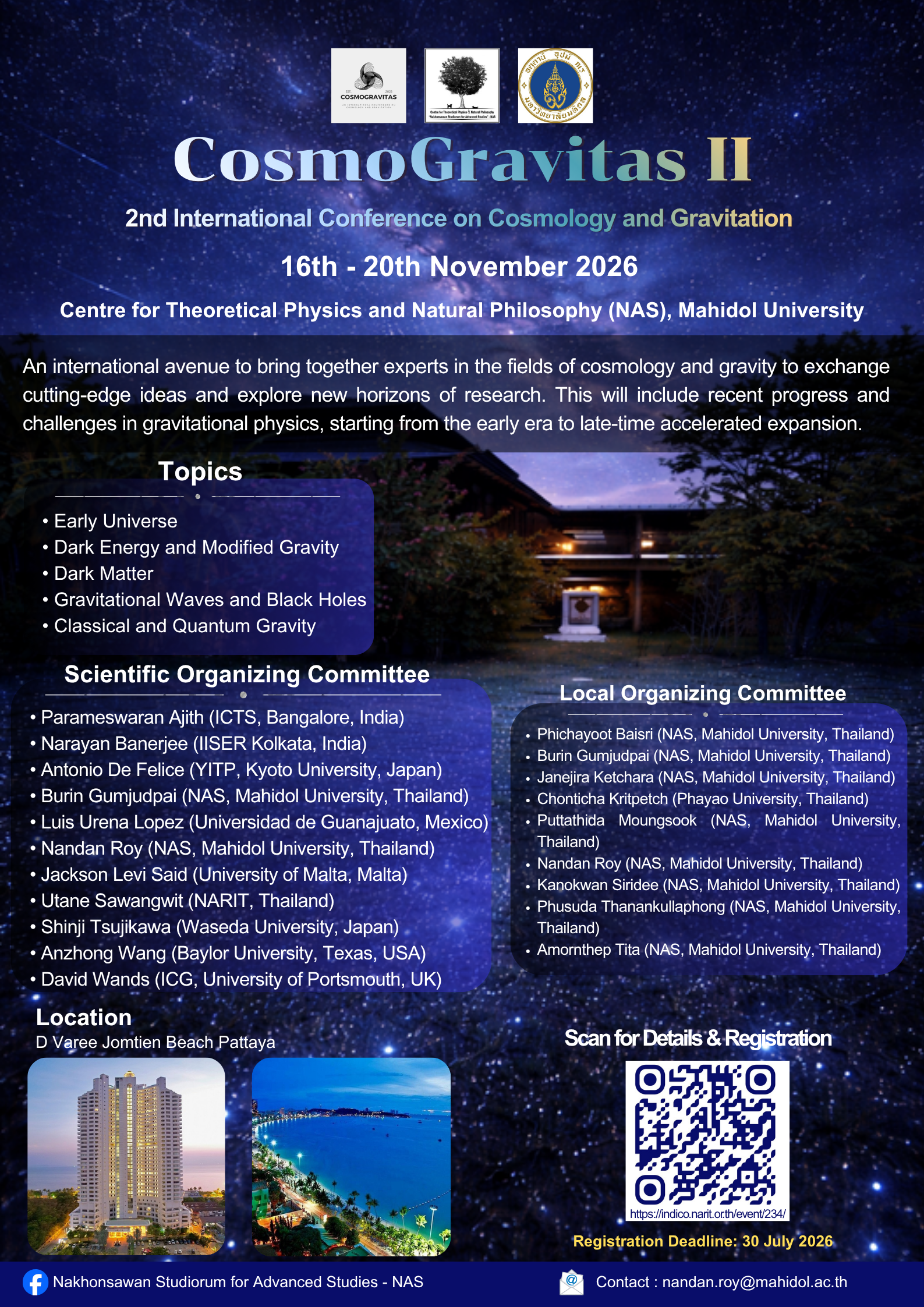
CosmoGravitas II

→ Asia/Bangkok
D Varee Jomtien Beach Pattaya Hotel (Pattaya, Thailand)

D Varee Jomtien Beach Pattaya Hotel

Pattaya, Thailand

457 Moo 12 Jomtien, Soi 13-14 Beach Road, Nongprue, Banglamung, Chonburi, 20150 Jomtien Beach, Thailand
Nandan Roy
Description

The first CosmoGravitas conference, held in June 2024, was successfully organized with strong international participation and highly positive academic feedback. The event demonstrated the growing interest and research activity in cosmology and gravitation, and significantly strengthened international collaboration networks.

Building on this established foundation, the second CosmoGravitas conference aims to further expand international engagement and deepen research cooperation in fundamental physics. The meeting will bring together leading experts in cosmology and gravitation to exchange ideas, foster collaboration, and explore new directions in theoretical and observational research.

Particular emphasis will be placed on recent developments in gravitational wave physics, alternative theories of gravity, and both early- and late-time cosmology. The conference will cover the following major themes:

  1.     Early Universe
  2.     Dark Energy and Modified Gravity
  3.     Dark Matter
  4.     Gravitational Waves and Black Holes
  5.     Classical and Quantum Gravity

Given the rapid development in these areas, particularly after the detection of gravitational waves and the increasing precision of cosmological observations, an international platform for scientific exchange is both timely and essential.

-----------------------------------------------------------------------------------

IMPORTANT SECURITY WARNING: Fraudulent Accommodation Services or Travel Booking Services


The Scientific Organizing Committee (SOC) of CosmoGravitas II (2026) has been made aware of fraudulent emails being sent to conference participants regarding accommodation bookings or travel.

Please be cautious of unauthorized communications from entities claiming to handle hotel reservations for the conference, specifically:

Please note the following critical details:

  • No External Agencies: The CosmoGravitas 2026 organizing committee has not hired or authorized any external travel agency or accommodation service to manage hotel bookings or coordinate with participants.
  • Direct Bookings Only.
  • Protect Your Information: If you are contacted by "Converia Travels" or any other unauthorized third party:
    • Do not reply to the email.
    • Do not share any personal details, financial information, credit card numbers, or travel details.
    • Do not click on any links or make any payments.

If you receive any suspicious emails or require verification regarding your accommodation and local hospitality, please contact us directly at [email protected] or [email protected].


Thank you for your vigilance and cooperation.

-------------------------------------------------------------------------

Registration Fees:

  - Faculty Members and Postdoctoral Fellows: 3,500 Baht (THB)
  - Students: 2,500 Baht (THB)

Students and postdoctoral fellows can apply for registration fee waiver.

Limited accommodation support is available for selected students or postdoctoral fellows.


Please upload your CV. A recommendation letter should be submitted directly by your supervisor to [email protected]

Important Dates:

  • 25 June – 16 August 2026: Registration and Abstract Submission

  • 16 August– 5 September 2026: Notification of Acceptance

  • 1 September – 30 September 2026: Registration Payment


Scientific Organizing Committee (SOC) 

  • Parameswaran Ajith (ICTS, Bangalore, India)
  • Narayan Banerjee (IISER Kolkata, India)
  • Antonio De Felice (YITP, Kyoto University, Japan)
  • Burin Gumjudpai (NAS, Mahidol University, Thailand)
  • Luis Urena Lopez (Universidad de Guanajuato, Mexico)
  • Nandan Roy (NAS, Mahidol University, Thailand)
  • Jackson Levi Said (University of Malta, Malta)
  • Utane Sawangwit (NARIT, Thailand)
  • Shinji Tsujikawa (Waseda University, Japan)
  • Anzhong Wang (Baylor University, Texas, USA)
  • David Wands (ICG, University of Portsmouth, UK)

Local Organizing Committee (LOC) 

  • Phichayoot Baisri (NAS, Mahidol University, Thailand)
  • Burin Gumjudpai (NAS, Mahidol University, Thailand)
  • Janejira Ketchara (NAS, Mahidol University, Thailand)
  • Chonticha Kritpetch (Phayao University, Thailand)
  • Puttathida Moungsook (NAS, Mahidol University, Thailand)
  • Nandan Roy (NAS, Mahidol University, Thailand)
  • Kanokwan Siridee (NAS, Mahidol University, Thailand)
  • Phusuda Thanankullaphong (NAS, Mahidol University, Thailand)
  • Amornthep Tita (NAS, Mahidol University, Thailand)

Speakers

  1. Avik De (Universiti Malaya, Malaysia)
  2. Antonio De Felice (Yukawa Institute for Theoretical Physics, Kyoto University, Japan)
  3. Eleonora Di Valentino (University of Sheffield, UK)
  4. T R Govindarajan (The Institute of Mathematical Sciences, Chennai India and Krea University, India)
  5. Takashi Hiramatsu (Nihon University, Japan)
  6. Laura Iacconi (Queen Mary, U. of London, UK)
  7. Masashi Kimura (Daiichi Institute of Technology, Japan)
  8. Luis Urena Lopez (Universidad de Guanajuato, Mexico)
  9. Ryo Saito (Yamaguchi University, Japan)
  10. Peera Simakachorn (Khon Kaen University, Thailand)
  11. Shinji Tsujikawa (Waseda University, Japan)
  12. Kent Yagi (University of Virginia, USA)
  13. Roy Maartens (University of the Western Cape, SA)
  14. Elisa G. M. Ferreira (Tokyo U., IPMU)
  15. Atsushi Naruko (NIT, Fukui)

Our Sponsors


Participants
  • Aarav Shah
  • Akshara SUJA BABU
  • Alberto Maya
  • Arpita Mitra
  • Ashmita .
  • Avijit Chowdhury
  • Bisweswar Sen
  • Chakkrit Kaeonikhom
  • Debanjan Debnath
  • DEBOJIT PAUL
  • Dr. Sanasam Surendra Singh
  • Elangbam Chingkheinganba Meetei
  • Haraprasad Nandi
  • Jishnu Sai Puthiyedath
  • Kavya Nagarakodige Shashikantha
  • Kraiwut Dakam
  • Madhurima Choudhury
  • Mahendra Goray
  • Malavika K
  • Meghanil Sinha
  • Narakorn Kaewkhao
  • Pakkapon Phaitha
  • Pansuek Khamkaen
  • Paul Patispantin
  • Piyabut Burikham
  • Pranjali Bhattacharjee
  • Pratik Premadarshi Ray
  • Priyanka Saha
  • RAJ KUMAR DAS
  • Ritwika Ghoshal
  • SAEED ULLAH KHAN
  • SAI SWAGAT MISHRA
  • Saikat Chakraborty
  • Sampurna Bhar
  • Shibendu Gupta Choudhury
  • Sourav .
  • Supawit Wadsathorn
  • thiti sirithanakorn
  • Vipin Sharma
  • Vladimir Dzhunushaliev
  • Zahra Davari Dolatabadi
    • 09:00 → 09:20
      Opening ceremony 20m
    • 09:20 → 09:30
      Break 10m
    • 09:30 → 10:30
      Plenary — Shinji Tsujikawa: Dark Energy with Stable Phantom-Divide Crossing: Model Construction and Observational Constraints 1h

      Recent cosmological observations have revived interest in dark energy whose equation of state evolves from below -1 to above -1 at low redshift. In this talk, I will discuss how to construct theoretically consistent models realizing this transition and test them against observations. I will first explain the obstacles to achieving such a crossing in shift-symmetric Horndeski and generalized Proca theories with luminal gravitational-wave propagation and no direct dark-matter couplings. I will then present two ways to overcome these obstacles: introducing a scalar potential that breaks shift symmetry in a Horndeski model, and combining a generalized Proca vector field with a canonical scalar field. Particular attention will be paid to the conditions ensuring the absence of ghost and gradient instabilities, as well as the implications for matter clustering and gravitational lensing. I will also present constraints on a scalar-vector-tensor dark-energy model using the DES five-year supernova sample, second-release DESI baryon acoustic oscillation measurements, compressed cosmic microwave background constraints, and growth data from redshift-space distortions. The results allow stable crossing histories and improve the best-fit likelihood relative to flat ΛCDM. I will discuss Bayesian model comparison, including its sensitivity to theoretical viability conditions and prior normalization, and the prospects for distinguishing these models through cosmic expansion and structure growth.

    • 10:30 → 11:00
      Coffee break 30m
    • 11:00 → 12:00
      Plenary — Antonio De Felice: From Data to Dynamics: A Simple Phantom-Crossing Dark Energy Parametrization 1h

      Is the time dependence of dark energy genuinely complicated, or can current observations be described by a much simpler expression?

      I will present a data-driven approach to this question within VCDM, a minimally modified theory of gravity that allows a consistent treatment of cosmological perturbations even when the effective dark-energy equation of state crosses the phantom divide.

      We begin by reconstructing the dark-energy equation of state using Bayesian splines constrained by cosmic microwave background, baryon acoustic oscillation, and Type Ia supernova observations. The reconstruction favors relatively smooth histories, while Bayesian evidence does not justify introducing excessive functional complexity. We then employ exhaustive symbolic regression to identify compact and interpretable analytic expressions compatible with the reconstructed evolution.

      A particularly interesting outcome is the one-parameter form (w(a) = w_0/\sqrt{a}), which provides a competitive fit compared with conventional two-parameter parametrizations, including CPL.

      Its simplicity leads to concrete predictions: the phantom-crossing redshift is determined by the single parameter (w_0), the effective dark-energy density is suppressed at early times, and the phantom phase is transient, avoiding a future big-rip singularity.

      I will discuss the observational implications of this result and explain how the underlying VCDM dynamics can accommodate phantom crossing without introducing an additional propagating scalar degree of freedom.

    • 12:00 → 13:00
      Lunch 1h
    • 13:00 → 13:15
      Contributory: Can Gravity Take Us Beyond the Standard Picture of the Universe? Cosmology in Extended Proca-Nuevo Gravity 15m

      The success of the ΛCDM model is tempered by unresolved questions surrounding the nature of dark energy and the cosmological constant. These challenges motivate the exploration of modified theories of gravity as viable alternatives to General Relativity. In this talk, I present the Extended Proca-Nuevo (EPN) framework, a ghost-free vector–tensor theory in which a massive spin-1 field drives the late-time evolution of the Universe. I will discuss the background cosmology and its implications for possible aspects of alleviating cosmological tensions. I will highlight recent observational constraints from current cosmological datasets, demonstrating the potential of the EPN framework as a promising candidate for cosmology beyond the standard model.

      Speaker: Dr Kavya Nagarakodige Shashikantha (Universiti Malaya)
    • 13:15 → 13:30
      Contributory: From CPL to Canonical Fields: Constraining Quintessence with the Tomographic AP Test 15m

      The nature of dark energy remains one of the central open questions in cosmology. While observational analyses commonly constrain phenomenological equation-of-state parametrizations such as the Chevallier–Polarski–Linder (CPL) model, theoretical interpretations require translating these constraints into physically motivated scalar-field models.

      We present a computational framework that directly maps observational likelihoods in the $(\Omega_m,w_0,w_a)$ parameter space onto the parameter spaces of canonical quintessence potentials without recomputing the full observational likelihood. The method employs likelihood-guided mapping based on the tomographic Alcock–Paczyński test combined with Type Ia supernova and baryon acoustic oscillation observations. For each potential, we solve the scalar-field background evolution numerically and determine an effective CPL representation over the observed redshift range, allowing observational constraints to be projected efficiently onto the underlying theoretical parameters.

      We apply this approach to exponential, pseudo–Nambu–Goldstone boson (PNGB), and inverse power-law (IPL) quintessence models. The resulting constraints reveal that viable scalar-field models occupy only a narrow region of the effective CPL parameter space, considerably smaller than the full phenomenological CPL posterior. This demonstrates how theoretical consistency substantially reduces the allowed dark-energy parameter space and provides a practical route for confronting fundamental dark-energy models with current and future cosmological observations.

      Speaker: Zahra Davari (Korea Institute for Advanced Study (KIAS))
    • 13:30 → 13:45
      Contributory: A unified framework to study $f$-family of modified gravity theories 15m

      I will introduce a neat mathematical framework that can be utilized to study, in a unified manner, different aspects of $f(R), f(T), f(G)$ or $f(Q)$ gravity. As an example of the application of this framework, I will show it's applicability for a comparative analysis between $f(R)$ gravity and the trivial FLRW connection branch of $f(Q)$ gravity, with respect to the two following questions: (1) provide a purely cosmographic measure on the deviation from GR based on the current data and (2) the behaviour of the underlying theory (more precisely, of it's deviation from GR) given a certain cosmological evolution. Time permitting, I will briefly introduce the direction of a further interesting application of this framework.

      Speaker: Dr Saikat Chakraborty (Institute of Research and Development, Duy Tan University, Vietnam)
    • 13:45 → 14:00
      Contributory: Breaking the Taylor Barrier in Cosmology 15m

      We present a unified analysis of the late-time cosmic expansion by bridging model-independent cosmography with modified gravity, using the latest DESI DR2 BAO data. A comparative study of Taylor, Padé, and Chebyshev expansions shows that while Taylor breaks down beyond low redshift, Padé approximants, especially (2,1), deliver stable, high-redshift reconstructions and are strongly preferred by information criteria, closely tracking LCDM. Leveraging this, we embed the Padé (2,1) framework within f(T) gravity and contrast it with direct dynamical solutions of the modified Friedmann equations. A comprehensive MCMC analysis with DESI DR2 and complementary probes reveals remarkable agreement between the two approaches, with both outperforming LCDM. Our results establish Padé cosmography as a powerful and reliable interface between data-driven reconstruction and fundamental gravity.

      Speaker: SAI SWAGAT MISHRA (BITS PILANI, Hyderabad Campus)
    • 14:00 → 14:15
      Contributory: Background and Perturbation Constraints on Spinor Field Dark Energy from Recent Cosmological Observations 15m

      We investigate a nonlinear self-interacting spinor field as a dynamical dark-energy candidate capable of driving the late-time accelerated expansion of the Universe. The model is formulated within a spatially flat Friedmann–Lemaître–Robertson–Walker framework, where the spinor field is minimally coupled to gravity and generates an effective dark-energy equation of state through its self-interaction potential. We study both the background and perturbation dynamics of the model, deriving the evolution of the Hubble parameter (H(z)), equation-of-state parameter (w(z)), deceleration parameter (q(z)), and the growth of matter density perturbations. The background parameters are constrained through a Markov Chain Monte Carlo (MCMC) analysis using recent observational datasets, including cosmic chronometers, Pantheon supernovae, and baryon acoustic oscillation measurements. To assess the impact on structure formation, we implement the model at the perturbation level and examine its predictions for the growth rate ($f\sigma_8$(z)), matter power spectrum, and the evolution of density fluctuations. We find that the spinor dark-energy scenario successfully reproduces the observed expansion history while remaining compatible with current large-scale structure measurements. The effective equation of state evolves dynamically and approaches the cosmological-constant limit at late times, while allowing mild deviations at intermediate redshifts. Statistical model comparison shows that the spinor-field framework provides a viable and competitive alternative to the standard $\Lambda$CDM cosmology, motivating further investigation with forthcoming high-precision surveys such as DESI, Euclid, and Rubin Observatory.

      Speaker: Dr Mahendra Goray (Dept. of Physics, S.P College, Sido Kanhu Murmu University, Dumka, Jharkhand)
    • 14:15 → 14:30
      Contributory: Dynamical analysis of Bianchi type-IX cosmology with a scalar field mediated dark sector interaction 15m

      The recent DESI DR2 preference for a time-varying dark-energy equation of state, together with the long-standing difficulty of explaining why an initially anisotropic universe should evolve toward isotropy, motivates the study of interacting dark-sector models in anisotropic backgrounds. We investigate the dynamics of Bianchi type-IX cosmologies containing pressureless dark matter coupled to dark energy in the form of a quintessence scalar field $\phi$ with exponential potential $V(\phi)=V_0\,e^{-\lambda\phi}$. Energy exchange between the two dark components is mediated by the scalar field through the interaction term $Q=\kappa\beta\dot\phi\,\rho_{\rm DM}$, where $\kappa^2=8\pi G$ and $\beta$ is a dimensionless coupling. Because Bianchi-IX models generically recollapse, the Hubble scalar $H$ vanishes at the moment of maximum expansion, where the expansion-normalized variables of the standard Wainwright-Ellis formalism diverge. We therefore adopt the $D$-normalized phase-space formalism of Hewitt, Uggla, and Wainwright, which compactifies the state space and remains regular through the recollapse, including the moment of maximum expansion at which $H = 0$. Together with the modified conservation equations for the two dark components, the Einstein Klein Gordon system reduces to a closed autonomous polynomial dynamical system, whose fixed points we classify by linear stability analysis, supplemented by center-manifold theory for the non-hyperbolic points. The fixed points shows the kinetic-dominated, coupling modified matter dominated, curvature scalar, scalar field dominated and coupled scaling families; the last is the anisotropic analogue of the Amendola scaling attractor. Restricting to the initially expanding, isotropizing trajectories, we map the region of the $(\lambda,\beta)$ plane in which anisotropic Bianchi-IX models approach an accelerating Friedmann Robertson Walker state.

      Speaker: Ashmita . (Khon Kaen University)
    • 14:30 → 15:00
      Break 30m
    • 15:00 → 15:02
      Flash Talk: Geometry and Stability of Wormholes in Symmetric Teleparallel Gravity with Dark Energy and Rotation Profiles 2m

      This work investigates wormhole geometries in the framework of symmetric teleparallel (f($\mathcal{Q}$)) gravity by incorporating holographic and mixed dark energy density profiles. Exact wormhole solutions are obtained using rotational velocity profiles to construct the redshift function and dark energy density profiles to determine the shape function. For suitable parameter choices, the solutions satisfy the flare-out condition and exhibit asymptotically well-behaved geometries. We further analyze the energy conditions, with particular emphasis on the null energy condition (NEC) at the wormhole throat, and demonstrate that the coupling parameter ($\gamma$) plays a significant role in governing NEC violation. In addition, the physical properties of the obtained wormholes are explored through the complexity factor, anisotropy, exoticity, and embedding diagrams, highlighting the viability of these solutions in modified gravity.

      Speaker: Mr Sourav NA (Central University of Haryana)
    • 15:02 → 15:04
      Flash Talk: Modified Chaplygin gas with recent observations in f(Q,B) gravity 2m

      In this work, we explore the cosmological dynamics of a modified gravity framework based on the function $f(Q,B)=\delta Q^{2}+\beta B$, where $Q$ denotes the nonmetricity scalar and $B$ is the boundary term that relates $Q$ to the Ricci scalar. The matter sector is modeled using the Modified Chaplygin Gas (MCG) with the equation of state $p=A\rho-\frac{D_{1}}{\rho^{\alpha}}$, allowing the model to interpolate between early-time matter behavior and late-time cosmic acceleration. By deriving an analytical expression for the Hubble parameter $H(z)$, we perform a parameter estimation using Markov Chain Monte Carlo (MCMC) techniques in conjunction with the latest cosmological observations: $46$ Hubble parameter measurements, $15$ BAO data points, DESI DR2 BAO data and the Pantheon+ Type Ia supernovae compilation. The best-fit values are obtained as $H_0=72.2814^{+3.4702}_{-4.5209}$ km/s/Mpc, $A_s = 0.6964^{+0.0779}_{-0.1258}$, $\alpha = 0.0027^{+0.0225}_{-0.0209}$ and $A = 0.0024^{+0.0702}_{-0.0464}$. The deceleration parameter transitions at redshift $z_{tr} \approx 0.946$, while the present-day value is $q_0 = -0.789$. The model yields an age of the Universe $t_0 \approx 13.53$ Gyr and a present EoS parameter $\omega_0 \approx -0.691$, which reflects the late-time acceleration consistent with observational bounds. These results demonstrate that the MCG scenario within $f(Q,B)$ gravity provides a viable and observationally consistent framework for explaining the late-time accelerated expansion of the Universe.

      Speaker: Dr. Sanasam Surendra Singh (NIT MANIPUR)
    • 15:04 → 15:06
      Flash Talk: Kuchowicz gravastars in Horava gravity and Einstein-aether theory 2m

      This work introduces a new gravastar model inspired by the Mazur-Mottola framework within Lorentz-violating gravity, specifically Hořava gravity and Einstein-aether theory with the help of Kuchowicz metric function. The proposed gravastar consists of three distinct regions: a de Sitter-like core, a thin shell filled with ultra-relativistic matter, and an exterior vacuum spacetime. Exact solutions obtained for each region demonstrate the consistency and viability of the model. A detailed investigation of the shell's physical properties, along with the other conditions confirms its stability and physical plausibility. The resulting gravastar solutions are free from singularities and event horizons, offering a compelling alternative to the conventional black hole paradigm in Lorentz-violating gravity theories.

      Speaker: Meghanil Sinha (National Institute of Technology Manipur)
    • 15:06 → 15:08
      Flash Talk: Fermion condensate at the event horizon 2m

      Some arguments are considered in favor of the idea that the canonical anticommutation relations for fermions should be modified in curved spacetime near the event horizon of a black hole. Such a modification is expected to lead to a change in the source term of the inhomogeneous Dirac equation describing the two-point Green’s function. By introducing an {\it ad hoc} source into the Dirac equation that mimics the modification of these anticommutation relations, stationary solutions are obtained and interpreted as two-point Green’s functions of fermions located near the event horizon. Owing to their stationarity, these Green’s functions describe a fermion condensate near the event horizon.

      Speaker: Vladimir Dzhunushaliev (al-Farabi KazNU)
    • 15:08 → 15:10
      Flash Talk: Observational constraints on Fractional Holographic Dark Energy in $f(T)$ gravity 2m

      We explore the cosmological implications of Fractional Holographic Dark Energy within the context of $f(T)=\beta(-T)^n$ gravity, in which the Hubble parameter is determined implicitly. The model incorporates fractional corrections through a generalized entropy-area relation, allowing for the inclusion of nonlocal effects in the dark energy sector. The model parameters are optimized using Hubble parameter measurements, DES supernova data 5 year, and BAO observations for DESI DR2 via a MCMC analysis. Our results show that the model remains consistent with current observational data and provides a viable cosmological scenario. The dynamical analysis indicates that the model maintains a positive energy density and a negative pressure throughout the cosmic evolution, ensuring physical consistency. The equation of state parameters exhibit a quintessence-like behavior at the present epoch and gradually evolve toward a cosmological constant-like phase at late times. The deceleration parameter confirms a transition from deceleration to acceleration at a redshift $z_t \approx 0.78$. Furthermore, the statefinder diagnostic reveals noticeable deviations from the $\Lambda$CDM model at intermediate redshifts, while approaching the standard fixed point $\{r,s\} = \{1,0\}$ in the asymptotic future. The estimated age of the Universe is also found to be consistent with observational constraints. Overall, the FHDE model within $f(T)$ gravity provides a physically consistent and observationally viable description of late-time cosmic acceleration, and may serve as a promising alternative to the standard $\Lambda$CDM paradigm.

      Speaker: Mr Chingkheinganba Meetei Elangbam (National Institute of Technology, Manipur, Imphal, India)
    • 15:10 → 15:12
      Flash Talk: Probing Energy Flow in the Dark Sector with DESI DR2 2m

      We investigate the possibility of energy exchange in the dark sector for interacting dark energy models, using the latest DESI DR2 baryon acoustic oscillation measurements. Our finding suggest that current observations do not provide significant evidence for dark sector interactions, but they allow the possibility of a weak energy flow that can be further tested with future high-precision cosmological surveys.

      Speaker: Vipin Kumar Sharma (Universty of Punjab, Lovely Professional University)
    • 15:12 → 16:30
      Poster viewing — Session A 1h 18m
    • 16:30 → 17:30
      Online Plenary — Eleonora Di Valentino: Cracks in the Standard Cosmological Model: Tensions, Robustness, and Hints of New Physics 1h

      The ΛCDM model has been extraordinarily successful in describing the Universe, but increasingly precise observations are beginning to expose cracks in this remarkably simple picture. The Hubble constant discrepancy remains the most striking example, while recent measurements of the expansion and growth histories of the Universe, together with cosmological constraints on neutrino masses, are adding new pieces to the puzzle. But which of these tensions are robust, and which depend on our choice of datasets, methodology, or cosmological assumptions? In this talk, I will examine the evidence behind the main cosmological tensions and ask what remains when these choices are varied. I will then explore whether the surviving discrepancies can be accommodated by extensions of the standard model, including dynamical dark energy, new early-Universe physics, and interactions in the dark sector. The emerging picture may not yet tell us what lies beyond ΛCDM, but it is beginning to tell us where (and how) we should look.

    • 09:30 → 10:30
      Plenary — Luis Ureña López 1h
    • 10:30 → 11:00
      Break 30m
    • 11:00 → 12:00
      Plenary — Takashi Hiramatsu: Cosmological Constraints on Extended Theories of Gravity from CMB Observations 1h

      The late-time accelerated expansion of the Universe, revealed by observations of Type Ia supernovae and other cosmological probes, may be explained by extensions of general relativity. Various extended theories of gravity have been proposed to explore gravitational physics beyond general relativity. In this talk, I will focus on constraining such theories using observations of the cosmic microwave background (CMB). In particular, I will consider degenerate higher-order scalar-tensor (DHOST) theories, generalised Proca theories, and a model propagating only two tensor degrees of freedom. To investigate these theories, we have developed a Boltzmann solver incorporating the effective field theory (EFT) approach to gravity. Using this solver, we perform Markov chain Monte Carlo (MCMC) analyses with the Planck 2018 likelihood to derive observational constraints on the EFT parameters characterising each model.

    • 12:00 → 13:00
      Lunch 1h
    • 13:00 → 14:00
      Online Plenary — Elisa G. M. Ferreira: Probing the Particle Physics of Ultralight Dark Matter: From Galaxies to the Solar System 1h

      Small-scale astrophysical observations provide a powerful window into the particle physics properties of dark matter. In this talk, I will focus on ultralight dark matter and discuss how its distinctive predictions for different astrophysical systems can be used to constrain the particle mass. I will highlight the current observational bounds and the assumptions and systematic uncertainties affecting their interpretation. I will also discuss how these observations can provide information about other fundamental properties of ultralight bosons, including their spin, self-interactions, and fractional abundance. Finally, I will discuss how our own Solar System can provide new ways to probe the particle physics properties of ultralight dark matter.

    • 14:00 → 14:15
      Contributory: JWST-informed Cosmological Inference from 21-cm Tomography 15m

      The redshifted 21-cm line of neutral hydrogen provides a unique probe of the high-redshift Universe, tracing the evolving state of the intergalactic medium (IGM) during the Epoch of Reionization (EoR). The 21-cm signal, however, depends on both the underlying cosmological density field and the astrophysical properties of the sources driving reionization, leading to potentially strong degeneracies between cosmological and astrophysical parameters. This degeneracy presents a fundamental challenge for extracting robust cosmological information from 21-cm observations alone. Observations of high-redshift galaxies with the James Webb Space Telescope (JWST) provide complementary information on the population of sources responsible for ionizing the IGM. In this work, we investigate a JWST-informed framework for extracting cosmological information from 21-cm tomography. We construct simulated EoR lightcones spanning a joint parameter space of cosmological and astrophysical parameters and generate corresponding galaxy observables, including UV luminosity functions, together with the 21-cm signal. We first use the JWST-like galaxy observables to constrain the properties of the underlying galaxy population and use these constraints as informative priors on the astrophysical parameters entering the 21-cm forward model. We then employ machine-learning-based inference to recover cosmological parameters from the 21-cm field while marginalizing over the remaining astrophysical uncertainties. By comparing 21-cm-only and JWST-informed inference, we quantify how external information on the high-redshift galaxy population changes the cosmological posterior and the associated astrophysics–cosmology degeneracies.

      Speaker: Madhurima Choudhury (Birla Institute of Technology and Science, Pilani - Hyderabad campus.)
    • 14:15 → 14:30
      Contributory: Model-Independent Evidence for a Localized Anomaly in the Late-Time Expansion History 15m

      In this talk, I present a model-independent spline reconstruction of cosmological distances using latest low-redshift datasets to investigate the late-time expansion history of the Universe. Comparing the reconstructed expansion history with the prediction of the Planck $\Lambda$CDM model, I demonstrate a localized deviation over a certain redshift interval which reaches a maximum significance of approximately 3.5$\sigma$ near $z=0.47$. I further demonstrate that this feature persists under substantial variations of the reconstruction methodology, dataset composition and sound-horizon calibration. I argue using mock analyses that the reconstruction is unbiased and that the observed anomaly is unlikely to arise from reconstruction bias or miscalibrated uncertainties. If confirmed by future observations, this localized feature could point to previously unrecognized late-time physics or reveal subtle inconsistencies between early and late Universe cosmological probes.

      Speaker: Shibendu Gupta Choudhury (Indian Institute of Astrophysics)
    • 14:30 → 15:00
      Break 30m
    • 15:00 → 16:00
      Online Plenary — Roy Maartens: Testing the Standard Model of Cosmology 1h

      The standard LCDM model of cosmology has been highly successful in fitting the data from numerous cosmological surveys. Nevertheless, it is always good physics to test the standard model. In addition, various tensions are emerging in the data, especially the Hubble tension, which may indicate problems with the standard model. I will give an overview of the key features of the model that can be tested. Then I will give examples and updates on some of these tests.

    • 16:00 → 16:15
      Contributory: Testing Sub-Horizon Approximations in Interacting Dark-Sector Cosmology 15m

      Sub-horizon and quasi-static approximations are widely employed in cosmological simulations to efficiently model the evolution of perturbations in theories beyond $\Lambda$CDM. However, their validity can depend on the underlying dark-sector physics and the scales being considered. In this work, we investigate these approximations in an interacting scalar-field dark-sector model, where dark matter and dark energy are coupled. We derive the full linear perturbation equations and obtain their sub-horizon and quasi-static limits, allowing a direct comparison between the approximate and full dynamics. We study the resulting evolution of matter perturbations and compare the interacting model with $\Lambda$CDM and a non-interacting scalar-field scenario. This provides a systematic assessment of when the approximations accurately capture the underlying perturbation dynamics and how dark-sector interactions can modify their validity. Our results are relevant for interpreting and improving the treatment of interacting dark-sector models in cosmological simulations and large-scale-structure studies.

      Speaker: Priyanka Saha (IIT kanpur)
    • 16:15 → 16:30
      Contributory: Inflationary trispectrum of gauge fields from scalar and tensor exchanges 15m

      In this paper, we compute the inflationary trispectrum of primordial gauge fields generated through the scalar and tensor exchanges in models with spectator U(1) gauge fields which are kinetically coupled to the inflaton. Focusing on the connected four-point autocorrelation function of gauge fields, we derive exact analytical expressions for the full trispectrum of both electric and magnetic fields using the in-in formalism and cosmological diagrammatic rules, and explore their respective contributions in specific momentum configurations. For the scalar exchange, we find that the trispectrum signal in the equisided configuration grows with the exchange momentum and reaches its maximum in the flattened limit. However, in the counter collinear limit, we show that the non-linearity parameter associated with the trispectrum scales quadratically with the corresponding parameter of the cross-correlation bispectrum of magnetic fields and curvature perturbations, thereby establishing a hierarchical relation between the higher- and lower-order correlation functions. For the tensor exchange, the trispectrum displays a richer angular dependence, reflecting the sensitivity to the orientation of the momentum quadrilateral with respect to the tensor polarisation, producing characteristic angular modulations in the trispectrum. Detecting such angular signatures in future high-precision cosmological observations would provide a novel window into tensor-mediated interactions in the early universe.

      Speaker: Jishnu Sai Puthiyedath (Ewha Womans University, Seoul)
    • 16:30 → 16:45
      Contributory: Non-Trivial Cosmology from Fractal Spacetime, Memory Effects, and Modified Gravity 15m

      The success of the $\Lambda$CDM model and General Relativity has established the standard paradigm of modern cosmology, yet the fundamental nature of spacetime remains an open question. This talk explores three complementary directions for extending the geometric foundations of modern cosmology. I first consider inflation in a fractal spacetime, where non-integer spatial dimensions modify the inflationary dynamics and the Mukhanov–Sasaki equation through an effective momentum $k_{\rm{eff}}$, leading to corrections in the scalar power spectrum and spectral index $n_s$. Confronting the Starobinsky model with Planck 2018 observations constrains the effective dimension to the range $D \approx [2.7,3]$, while fractal corrections render Natural Inflation phenomenologically viable with sub-Planckian axion decay constants. I then extend the semiclassical Wheeler-DeWitt framework by incorporating a causal non-Markovian memory, leading to an effective non-integer temporal dimension that introduces an additional contribution to the primordial power spectrum with a $k^{3/4}$ scaling, enhancing high-$\ell$ CMB temperature anisotropies and producing scale-dependent modifications of primordial non-Gaussianity. Finally, I present a De Donder-Weyl formulation of Einstein-Cartan cosmology, where torsion generalizes the underlying spacetime geometry, yielding torsion-modified Friedmann equations and demonstrating the limitations of conventional power-law cosmological solutions. Together, these studies investigate the cosmological consequences of extending spacetime through non-integer spatial and temporal dimensions and torsion, providing new perspectives on physics beyond the standard cosmological paradigm.

      Speaker: Aarav Shah
    • 16:45 → 17:00
      Contributory: Aspects of Spontaneous Symmetry Breaking in Cosmology 15m

      We explore if a late-time cosmic acceleration and a mild variation of fundamental constants can be accommodated within a common scalar-tensor framework. The fundamental constants we focus on are the Newtonian gravitational coupling $G$ and the electron mass $m_e$. The scalar-tensor framework under consideration is a generalized Brans-Dicke theory with an additional matter field. The viability of this framework is explored in the context of well-established late-time cosmic expansion history, namely, a standard $\Lambda$CDM expansion and an extended $\Lambda$CDM expansion (where a rational (Pad\'e-like) deformation is considered). We reconstruct and show that the resulting effective potential of the matter field naturally develops a Higgs-like symmetry-breaking structure with a redshift-dependent mass term, leading to a mild evolution of the vacuum expectation value. This variation leads to an evolution of proton-to-electron mass ratio $\mu$ which is compared with observational bounds derived from quasar absorption spectra. We find that in order to accommodate a reasonably mild variation of $\mu$, the Brans-Dicke scalar field must behave as a chameleon.

      Speaker: Malavika K (Vellore Institute of Technology)
    • 17:00 → 17:15
      Contributory: The Ringdown and the Tide: Fingerprints of Dark Matter Halo Profiles 15m

      Astrophysical black holes are expected to reside in environments enriched by dark matter, raising the possibility that environmental effects may leave observable imprints on gravitational-wave signals. We investigate how the structure of a surrounding dark-matter halo modifies both the ringdown and tidal response of a static, spherically symmetric black hole. The halo is modelled using a generalized $(\alpha,\beta,\gamma)$ density profile within the Einstein cluster framework. We compute the quasinormal mode spectrum and static axial tidal Love numbers, and examine their dependence on the halo compactness and density profile. We show that the halo induces a characteristic redshift of the quasinormal frequencies and damping rates, with the strongest influence arising from the inner halo structure. Time-domain evolutions confirm the frequency-domain results and exhibit late-time tails whose behaviour is governed by the outer density profile. We further demonstrate that the tidal Love number probes the halo through a different radial weighting than the ringdown spectrum, making the two observables complementary. Our results suggest that combining ringdown and tidal measurements can help constrain the spatial distribution of dark matter around black holes and distinguish environmental effects from genuine deviations of the vacuum black-hole geometry.

      Speaker: Avijit Chowdhury (Indian Institute of Astrophysics)
    • 09:30 → 10:30
      Plenary — T.R. Govindarajan 1h
    • 10:30 → 11:00
      Coffee break 30m
    • 11:00 → 12:00
      Plenary — Ryo Saito: Probing the Early Universe with Gravitational-Wave Background Anisotropies: Universal Structures at Large Angles 1h

      The stochastic gravitational-wave background (SGWB) offers a new window onto the early Universe. While its sky-averaged spectrum is the primary target of current searches, distinct primordial and astrophysical mechanisms can produce similar spectra over a finite observational band. Angular anisotropies provide complementary information that may help identify the origin of a signal.

      The importance of such information is familiar from the cosmic microwave background (CMB). In particular, large-angle CMB anisotropies trace primordial perturbations that were superhorizon at recombination and therefore provide a relatively direct window into inflationary initial conditions. SGWB anisotropies may offer a similar probe, potentially retaining information from epochs far earlier than recombination. At the same time, important differences exist between CMB and SGWB observations. I will discuss how these similarities and differences determine which angular information can be extracted from SGWB observables and how it should be interpreted.

      To organize primordial SGWB anisotropies, I will introduce the Cosmological Form Factor (CFF), a model-independent framework describing their response to cosmological long-wavelength perturbations. The CFF characterizes how long modes modulate local short-scale GW statistics and connects observable anisotropies to cosmological correlation functions. This connection allows general principles, including statistical isotropy and locality, to determine the angular and polarization structures, while amplitudes, frequency dependence, and source-time dependence retain information about the underlying mechanism. Both propagation and fossil effects arise as representative realizations of this common framework. As an application, I will show that nearly scale-invariant scalar long modes yield a universal Sachs–Wolfe-like large-angle scaling.

    • 12:00 → 13:00
      Lunch 1h
    • 09:30 → 10:30
      Online Plenary — Kent Yagi: Gravitational-Wave Tests of String-Inspired Gravity 1h

      Gravitational waves provide a unique window into the strong-field regime of gravity, offering unprecedented opportunities to test general relativity and search for signatures of new physics. In this talk, I will focus on Einstein-dilaton-Gauss-Bonnet gravity, a quadratic modification of general relativity motivated by string theory. I will first discuss the post-Newtonian corrections that arise during the inspiral phase of compact binary coalescences and review current observational constraints obtained from inspiral signals. I will then describe how black hole ringdown frequencies are modified in this theory and the corresponding constraints from ringdown observations. Accurately modeling the merger phase requires numerical relativity simulations, which are computationally expensive and time-consuming. To address this challenge, I will present new approaches for constructing inspiral-merger-ringdown waveforms in Einstein-dilaton-Gauss-Bonnet gravity more efficiently, paving the way for stronger tests of string-inspired modifications to gravity with current and future gravitational-wave observations.

    • 10:30 → 11:00
      Coffee break 30m
    • 11:00 → 12:00
      Plenary — Masashi Kimura: Black Hole Quasinormal Modes and the Non-Uniqueness of Effective Potentials 1h

      Quasinormal modes (QNMs) describe the characteristic oscillations of black holes and play an important role in observations of the ringdown phase. These modes are determined by the effective potential in the master equation for gravitational perturbations, raising the question of to what extent the potential can be uniquely determined from the QNM spectrum. In this talk, we explore this question using Darboux transformations of the wave function. We examine under what conditions Darboux transformations yield physically reasonable effective potentials. We also discuss the implications of these transformations for interpreting black hole QNM spectra.

    • 12:00 → 13:00
      Lunch 1h
    • 13:00 → 14:00
      Plenary — Atsushi Naruko: Understanding Cosmological Perturbations through the Separate-Universe Approach 1h

      How much can we learn about an inhomogeneous universe from homogeneous background solutions? The separate-universe approach offers a remarkably simple way to address this question: on sufficiently large scales, different regions of the universe can be treated approximately as homogeneous universes, allowing us to follow the nonlinear evolution of cosmological perturbations without solving the full inhomogeneous equations.

      In this talk, I will introduce the basic physical picture of the separate-universe approach and its formulation in terms of the spatial gradient expansion. I will then explain how this leads to the δN formalism, which relates large-scale curvature perturbations to differences in the local expansion history. I will also discuss the assumptions underlying this description, why it works, and where its limitations become important. Finally, I will briefly touch upon extensions of the standard framework and recent developments in the study of nonlinear cosmological perturbations. The aim is to provide an accessible overview of the subject, emphasizing physical intuition and its usefulness for understanding the early universe.

    • 14:00 → 14:15
      Contributory: f(R) gravity scalarons near black hole horizon 15m

      The Galactic Center (GC) black hole Sgr A* gives us an opportunity to perform horizon scale tests of black hole physics and deviations from General Relativity, thanks to observations carried out by the Event Horizon Telescope (EHT). In this work we study the impact of the scalar degree of freedom (scalaron) of f(R) gravity theory on the size and shape of GC black hole by using a recently developed stationary, axisymmetric and vacuum metric of f(R) theory. We encounter a minimum bound of $10^{-17}$ eV for the scalaron mass using 1σ upper bound on the deviation parameter produced by EHT-Keck and EHT-VLT measurements. Lighter scalarons increase the shadow size beyond that measured by the EHT. The displacement and asymmetry in the shape of the black hole shadow are employed to test the no-hair theorem and it is observed that $10^{-16}$ eV scalarons yield the exact Kerr like shadow and a $6\%$ departure from the Kerr quadrupole. We infer preservation of the no-hair theorem for such scalaron mass and further examine the possibility of violation of the theorem. The same mass scale reproduces the PPN parameter $\gamma$ constrained in the weak field limit of the solar system. This is for the first time we report a convergence of horizon scale test and solar system test of f(R) gravity by using the scalaron mass. The prospect of constraining the scalaron mass using gravitational waves is an exciting avenue to be highlighted.

      Speaker: Pranjali Bhattacharjee (Gauhati University)
    • 14:15 → 14:30
      Contributory: Homothetic Killing Horizons in Vaidya and Kerr–Vaidya Black Holes 15m

      I would like to give a presentation in which I will discuss the existence and physical implications of homothetic Killing vectors (HKVs) in a broad class of dynamical Vaidya spacetimes, including generalized spherically symmetric Husain-type solutions and rotating Kerr–Vaidya geometries. By solving the conformal Killing equations, it can be demonstrated that these spacetimes admit a unique class of HKVs only when the dynamical parameters, namely the mass, charge, and rotation parameter, evolve linearly with the advanced null coordinate. For Kerr–Vaidya spacetimes, the existence of an HKV requires both the mass and angular momentum to be dynamical and satisfy a definite relation between their rates of evolution. The null hypersurface where the HKV becomes null defines a homothetic Killing horizon (HKH), providing a natural generalization of the Killing horizon for nonstationary black holes. The presence of an HKV allows the original dynamical spacetime to be conformally mapped to a stationary spacetime, thereby enabling the application of standard geometric methods associated with Killing horizons. Using this framework, we analyse the geometric and thermodynamic properties of HKHs by evaluating different notions of surface gravity and identifying the conformally invariant surface gravity relevant for dynamical black-hole thermodynamics. Finally, a maximal analytic extension of a self-similar charged Vaidya spacetime is constructed the HKH framework provides a suitable setting for investigating the particle creation by Hawking radiation in dynamical backgrounds. These results establish homothetic symmetry as a powerful organizing principle for understanding horizon geometry, thermodynamics, and quantum phenomena in a wide class of nonstationary black-hole spacetimes.

      Speaker: Ritwika Ghoshal (Indian Institute of Technology Kanpur)
    • 14:30 → 15:00
      Break 30m
    • 15:00 → 15:02
      Flash talk: Chaotic scattering in binary black hole systems 2m

      When we consider the the case of chaotic scattering in a region described by a potential or a massive object, we see that the behavior of particle trajectories are heavily dependent on initial conditions, which eventually decide whether particles stay in the scattering region or exit it through different exits. Initially, the H\'enon-Heiles potential is taken as a model to study these trajectories, where we can find that a scaling relation exists between the fraction of particles trapped in the potential as function of relativistic parameter $\beta$, when each of these particles are projected with a different set of initial conditions. We then try to investigate if similar scaling relations could be found for null geodesics propagating around a binary black hole system described by the Majumder-Papapetrou (MP) binary black hole solution. Our study can thus be able to demonstrate the use of nonlinear dynamics to find such an example of the existence of scaling laws in gravitational systems.

      Speaker: Sampurna Bhar (Indian Institute of Technology, Madras)
    • 15:02 → 15:04
      Flash talk: Phantom divide crossing with interacting scalar fields 2m

      The accelerated expansion of the Universe poses a serious challenge to our understanding about the dark sector, motivating the investigation of dark matter and dark energy within a unified framework. In this work, we deal with the analysis of two-interacting scalar field model inspired by the hybrid inflation potential. We initially perform the cosmographic reconstruction of the Hubble parameter utilising a modified parametrisation which is constrained by the Bayesian Markov Chain Monte Carlo (MCMC) method. The cosmographic parameters are estimated using the Observational Hubble Data, Baryon Acoustic Oscillation, Type Ia Supernovae, Cosmic Microwave Background, Cosmic Chronometers and Dark Energy Spectroscopic Instrument data. The reconstructed Hubble parameter is used as an input to numerically solve the coupled scalar field equations, analysing the evolution of the interacting scalar fields. The reconstructed scalar field dynamics are then utilised to explore the dark energy equation of state. Further, the evolution of deceleration, jerk and snap parameters are also studied to understand the cosmological aspects of the model. This work demonstrates a cosmographic approach in connecting the observational constraints with interacting scalar field dynamics, paving a way for understanding the unified dark energy models.

      Speaker: Akshara S B (VELLORE INSTITUTE OF TECHNOLOGY, VELLORE)
    • 15:04 → 15:06
      Flash talk: A Potential Black Hole Mimicker From Curvature-Matter Coupled Theory of Gravity 2m

      I wish to give a presentation, in which I will talk about a class of horizonless, regular ultra-compact objects which may arise in a theory of gravity where fluid variables may couple to the curvature scalar of the spacetime. This kind of non-minimal interaction between fluid variables and the Ricci scalar generates a vacuum-like equation of state in the interior, while the exterior remains exactly Schwarzschild. The interior and exterior spacetimes are glued through a infinitesimally thin-shell at the boundary of the spacetimes. The interior metric is regular everywhere and the shell has given a stiff-matter equation of state, and near-horizon compactness can potentially mimic black-hole phenomenology without a event horizon. Unlike the Mazur-Mottola gravastar and its variants, the present model predicts a typical ultra-compact mass-radius window, with masses in the range $1.4-2.1M_\odot$ and radii in the range $5-7$ km. In addition, this framework also predicts a unique geometric-thermodynamic shell temperature in the ultra-compact limit distinctly different from the Hawking temperature.

      Speaker: Debanjan Debnath (Indian Institute of Technology Kanpur)
    • 15:06 → 15:08
      Flash talk: Dark Energy and Black Holes 2m

      We study aspects of black-hole spacetimes in the presence of dark-energy components, focusing on how the equation of state and associated curvature diagnostics constrain physically distinct regimes. Starting from the Schwarzschild geometry, we derive the Kretschmann scalar as a coordinate-invariant measure of curvature and use it to characterize the behavior near the horizon and at the central singularity. We then discuss how dark-energy motivated modifications can be incorporated and how they affect invariant quantities and horizon structure. Our results provide a compact set of analytic expressions and checks that are useful for comparing different dark-energy/black-hole models.

      Speaker: Bisweswar Sen
    • 15:08 → 15:10
      Flash talk: Beyond ΛCDM: Probing Structure Growth and Observational Viability of Generalized f (Q, Lm) Gravity 2m

      $f(Q, \mathcal{L}_m)$ gravity is a well-known extension of $f(Q)$ gravity, obtained through non-minimal or additive minimal coupling in the action's Lagrangian density. Existing literature within the framework of $f(Q, \mathcal{L}_m)$ has explored the cosmographic scenario through various approaches, including background-level analyses and comparisons with $\Lambda$CDM (Myrzakulov et al., Phys.\ Lett.\ B 139506, 2025; Hazarika et al., Physics of the Dark Universe 50, 102092, 2025). In this work, we investigate the additive minimal coupling in a generalized power-law form, $f(Q,\mathcal{L}_m) = -Q^\mu + \alpha \mathcal{L}_m^{\,\nu} + \beta$, where $\mu$, $\nu$, $\alpha$, and $\beta$ are the extra degrees of freedom introduced by the model. We derive the key cosmological evolution equation, the Hubble function $H(z)$, by adopting a suitable novel parametrization. A distinctive feature of this theoretical framework is the non-conservation of the matter sector (a non-conserved continuity equation), which we highlight and study under the condition $\nu \neq 1$; this non-conservation is significant, as it effectively mimics a particle creation scenario. We constrain the model's free and extra parameters, and examine their effects on the cosmographic scenario, using Observational Hubble Data (OHD), Baryon Acoustic Oscillation (BAO) measurements from DESI DR2, and three Type Ia Supernovae (SNe Ia) catalogs (Pantheon+, Union3, and the Dark Energy Survey). Since our framework inherently involves non-conservation, we extend the analysis beyond the background level to the perturbative regime, deriving the perturbed field equations of $f(Q,\mathcal{L}_m)$ together with the perturbed Euler and continuity equations, and study the growth of structure and the impact of the non-conservation term on the growth equation, further performing a joint observational analysis incorporating the $f\sigma_8$ probe. To statistically assess our results, we performed a Bayesian evidence analysis, treating $\Lambda$CDM as the reference model; based on this analysis, our non-conservative model shows a statistical edge over $\Lambda$CDM in several cases, depending on the dataset combination used. These results position non-conservative $f(Q,\mathcal{L}_m)$ gravity as a physically motivated and observationally testable alternative to $\Lambda$CDM, rooted in an effective particle-creation mechanism.

      Speaker: Mr RAJ KUMAR DAS (Physics And Applied Mathematics Unit ,Indian Statistical Instiute Kolkata)
    • 15:10 → 15:12
      Flash talk: Late-Time Dynamics in Accelerating Nonlinear f (T ) Gravity via Hybrid Scale Factor : Bayesian Analysis and Cosmological implications 2m

      This study offers a comprehensive reconstruction of modified Teleparallel (f(T)) gravity model with three distinct non-linear as well as novel forms employing a hybrid scale factor to depict the expansion history of the universe. We investigate a physically motivated cosmological parametrization through this hybrid scale factor that can explain a smooth transition from an early decelerated epoch to the present accelerated evolution. This scale factor is then used to derive the corresponding model parameters. These parameters are rigorously constrained using the Monte Carlo Markov Chain (MCMC) analysis with the help of Bayesian statistics and incorporating late-time observations from Hubble, Baryon Acoustic Oscillations (BAO) and Patheon+SH0ES datasets. The investigation of dynamical parameters such as the equation of state parameter and cosmological parameters indicates alignment with an accelerated expansion phase in both the present and late time epochs. Validation is conducted by assessing the energy conditions, verifying the feasibility of the model forms with particular emphasis on the violation of the strong energy condition that indicates dark energy dominance in modified gravity scenarios. This investigation has been instrumental in determining models that remain consistent with cosmological observations and theoretical requirements. The reconstructed forms of the model effectively mimic ΛCDM at late times, providing significant insights into possible extensions of general relativity and bolstering f(T) gravity theory as a robust explanation for cosmic acceleration.

      Speaker: Dr Pratik P. Ray (Vellore Institute of Technology-AP University)
    • 15:12 → 16:00
      Poster viewing — Session B 48m
    • 16:00 → 17:00
      Online Plenary — Laura Iacconi: Primordial black holes from inflation: on the decoupling between large and small scales 1h

      Primordial black holes can be produced from the collapse of large perturbations generated from inflation on scales much smaller than those seeding the large-scale structure formation.

      It is possible that the large peak in scalar power at high wavenumbers might induce corrections to the scalar power spectrum on large scales, e.g. in the form of loop corrections, endangering the success of inflation in explaining the observed statistics of primordial perturbations.

      In this talk, I will give an update on recent debates on the viability of such inflationary scenarios.

      I will demonstrate that the 1-loop correction to a large-scale adiabatic mode due to a band of enhanced short-scale perturbations decouples from all detailed properties of the peak, including its maximum amplitude, and does not lead to an observable effect.

    • 09:30 → 10:30
      Plenary — Peera Simakachorn 1h
    • 10:30 → 11:00
      Coffee break 30m
    • 11:00 → 12:00
      Plenary — Avik De: The Non-Metricity Gravity Approach 1h

      General Relativity formulates gravitation through spacetime curvature using the Levi-Civita connection, which assumes both vanishing torsion and zero non-metricity. However, alternative geometric descriptions exist within the Geometric Trinity of Gravity. Among these, Non-Metricity Gravity, specifically (f(Q)) gravity and its scalar-tensor extensions, attributes gravitational interactions strictly to the non-metricity tensor, setting curvature and torsion tensors to zero while introducing coupled scalar fields to unlock rich, dynamical behaviors.

      A crucial feature that makes modified non-metricity theories particularly intriguing is that the affine connection is no longer uniquely fixed by the metric tensor alone. In isotropic and homogeneous spacetimes, such as the FLRW universe, the requirement of zero curvature and zero torsion yields three distinct classes of affine connections. Similarly, applying these geometric constraints to static spherically symmetric systems reveals two independent classes of connections.

      These non-trivial connection classes transform the study of non-metricity gravity from a simple metric modification into a deep structural probe of spacetime geometry. Depending on which connection branch is realized, the underlying non-metricity scalar (Q) acquires completely different dynamic expressions. This mathematical degree of freedom allows identical spatial metrics to yield dramatically different field equations, influencing late-time cosmic acceleration, inflationary dynamics, and black hole or stellar solutions. This work highlights how exploring these distinct connection choices opens up compelling new pathways for understanding fundamental gravity.

    • 12:00 → 12:15
      Contributory: Classical Eikonal for Binary Black Hole Scattering in Dark Matter Backgrounds 15m

      Despite significant advances in post-Minkowskian gravity, scattering-amplitude methods, and gravitational-wave modeling, existing frameworks largely assume vacuum binary dynamics and do not systematically incorporate coherent environmental effects. We develop a unified Hamiltonian framework for compact binaries embedded in coherent ultralight dark matter, combining post-Minkowskian gravity with Hamiltonian deformation theory, the classical interaction picture, and the Magnus expansion. The resulting eikonal captures dark matter–induced corrections to gravitational-wave observables, providing a systematic framework and potential avenue for probing ultralight dark matter with gravitational-wave observations.

      Speaker: Arpita Mitra (CTP NAS, Mahidol University, Nakhon Sawan campus)
    • 12:15 → 12:30
      Contributory: Nature of the dark matter distribution near the Galactic Center black hole: Insights from stellar orbital precession 15m

      Abstract:
      The stellar orbits near the Galactic Center black hole provide a unique probe for understanding the nature of mass distribution as well as carrying out tests of gravity. Inferring the nature of mass distribution in the region is crucial for understanding the formation history of the black hole and how it interacts with its environment. In this work we consider several viable dark matter models and constrain the parameters of the models which are consistent with the latest bound on dark mass near the Galactic Center. The pericenter shift of stellar orbits in presence of such mass distributions are worked out. We compare the dark matter precession with general relativistic precession and identify regions where dark matter induced effects might be dominant. We consider 13 S-stars that have passed or expected to pass their pericenter within the next decade. The prospect of detection of the dark matter effects in these stellar orbits through existing and upcoming large telescopes have been explored. In the orbit of S2, the effect of the different dark matter profiles along with some modified gravity models is investigated. It is seen that the orbit of S2 is insensitive to dark matter distribution but provides a good probe for testing modified gravity theories. Additionally, other stellar orbits with low eccentricity and large semi-major axis are found to be prominent probes for distinguishing different dark matter distributions. We identify five S-star orbits that can be used to distinguish between these mass profiles using observational facilities like Keck, Very Large Telescope and upcoming Thirty Meter Telescope.


      References:

      1. Paul D., Kalita S., 2026, MNRAS, 547, 2
      2. GRAVITY Collaboration et al., 2024, A&A, 692, A242
      Speaker: Mr Debojit Paul (Department of Physics, Gauhati University)
    • 12:30 → 12:45
      Contributory: Quintom dark energy: Future attractor and phantom crossing in light of DESI DR2 observations 15m

      We study the late-time cosmological dynamics of a two-field dark-energy model consisting of a canonical quintessence scalar field and a phantom scalar field in a spatially flat Friedmann-Lemaître-Robertson-Walker universe. The fields are minimally coupled to gravity and uncoupled at the level of the potential, with the quintessence sector governed by an exponential potential and the phantom sector by an inverse power-law potential. By reformulating the background equations as a five-dimensional autonomous dynamical system, we identify and analyze the fixed points and their stability properties, revealing stable late-time attractors corresponding to phantom-dominated accelerated expansion. We confront the model with observations through a Bayesian parameter estimation performed using the cobaya framework, employing several combinations of recent cosmological datasets, including Pantheon+ supernovae, compressed cosmic microwave background distance priors, DESI DR2 baryon acoustic oscillation measurements, and DES year-5 supernova data. The observational constraints favor a dynamical dark-energy sector moderately and are consistent with deviations from a cosmological constant at the present epoch. The regions of parameter space preferred by the data are compatible with the stable accelerating solutions identified in the dynamical analysis, establishing a direct connection between phase-space stability and observational viability. A notable feature of the model is that the effective dark-energy equation of state undergoes phantom divide crossing in a gradual and asymptotic manner, rather than as a sharp transition.

      Speaker: Phusuda Thanankullaphong (Centre for Theoretical Physics and Natural Philosophy, Mahidol University)
    • 12:45 → 13:00
      Summary and Closing 15m